It's already Sunday again, so it's another catch-up day in case you missed any of the previous week's lessons. It can also be a day for reviewing. So, here is a list of the lessons so far and their sayings; you can see what you might have missed along with anything that could use a little more practice. Each lesson title is a link that will take you to that lesson:
The focus for today's lesson is more masculine nouns and adjectives. Some of them are those second-declension nouns and adjectives that end in -us, like natus, mundus, totus, echinus and fumus, and there are also some second-declension nouns and adjectives that endsin -er: magister, pulcher and asper. You'll learn more about that pattern later.
The rest belong to the third declension with a variety of different endings: carcer, nemo, homo, minor, and ignis. Even though there is a variety of endings, there are some patterns there that you will start to recognize later on as you learn more and more of these third declension words.
So, here are today's proverbs:
1. Carcer numquam pulcher.
Prison (is) never pretty.
CAR-cer NUM-quam PUL-cher.
Latin carcer, "prison," gives us English "incarcerate." Latin nunquam, "never" has the negative prefix ne-, ne-umquam, "not-ever." just like English "never."
Latin pulcher, "pretty, beautiful," gives us English "pulchritude."
The charm of this proverb is the rhyme: carcer-pulcher.
2. Nemo magister natus.
No one (is) born (a) master.
NE-mo ma-GIS-ter NA-tus.
Latin nemo also has the negating ne- prefix; it is ne-homo, not-person, i.e. "nobody." You might know this word from the name of Captain Nemo in 20,000 Leagues under the Sea.
Latin "magister" means "master, teacher, chief, leader" and literally it means "greater." This is the origin of the English word "master." The opposite of magister in Latin is minister, "lesser" (related to the word minus), which is the origin of the English word "minister."
Latin natus means "born," as in English "neonatal." It is related to Latin natura (see yesterday's lesson).
The idea here is that learning takes time: you're not born with learning; you have to work to acquire it.
3. Homo mundus minor.
(A) person (is a) world in miniature.
HO-mo MUN-dus MI-nor.
You've seen homo before: Homo bulla.
You've also seen mundus before: Patria mea totus mundus est.
The word minor means "lesser, smaller," as in the English word "minor."
This saying expresses the idea that the nature of the cosmos and human nature are analogous: you can learn things about the cosmos from observing humans, and you can learn about humans from observing the cosmos. For more about this philosophy, see Wikipedia: Microcosm–macrocosm analogy.
You've seen totus before in that same saying above: Patria mea totus mundus est.
Latin echinus, "hedgehog," is a borrowing from Greek; many Latin words with "ch" are Greek borrowings. You can see this root in the plant name "echinacea" because of its spiny center.
Latin asper means "rough," both literally, like a hedgehog's spines, but also metaphorically, as in a rough situation, as in English "asperity."
This saying refers to a situation where there is no safe approach, or to a person who is going to be irritable no matter what you say or do: no matter where you grab the hedgehog, it's going to be prickly.
5. Fumus, ergo ignis.
(Where there is) smoke, therefore fire.
FU-mus, ER-go IG-nis.
From Latin fumus, "smoke," we get English words like "fume" and "fumigate."
We use Latin ergo, "therefore," in English: "ergo." You may already know this famous Latin phrase: Cogito, ergo sum, "I think, therefore I am."
You can see Latin ignis, "fire," in the English words like "ignite" and "igniferous."
The focus for today's lesson continues to be masculine nouns, and today there are some masculine nouns that belong to different declensions. It's not important for you to memorize which words belong to which declension, although that will be important later on. For now, just be aware that the masculine nouns do belong to different declension groups, just as the feminine nouns do.
You can always use the masculine nouns slideshow (also in blog sidebar) to keep track of these different groups because the slides are color-coded: most masculine nouns and adjectives belong to the second declension and have a blank slide background, while the third declension nouns and adjectives are marked with a blue background and the fourth declension is yellow.
The noun risus is formed from the verb ridere, "to laugh." Although it ends in -us, this is actually a fourth declension noun. When you turn a Latin verb into a noun like this, it is often a masculine noun of the fourth declension ending in -us. You'll learn more about how that works later.
You've seen optim- before: Mediocritas optima est.
Notice that the adjective optima is agreeing here with medicina, a feminine noun, not with risus, which is masculine. So, that helps you see how the sentence is structured: Risus || optimamedicina, with risus as the subject and optimamedicina as the predicate.
As you can tell, from Latin medicina we get English "medicine."
2. Fames optimus est coquus.
Hunger is (the) best cook.
FA-mes OP-ti-mus EST CO-quus.
The noun fames, "hunger," is a feminine noun of the third declension. From this Latin root we get English "famine" and "famished."
The noun coquus, "cook," is the origin of English "cook." In English, you cannot tell if "cook" is a noun or a verb, but in Latin, you can tell the difference: coquus is the person who cooks, while coquere is the verb "(to) cook."
In this saying, you see the form optimus because it is agreeing with coquus, a masculine noun. Notice also how the noun phrase wraps around the verb est: optimus...coquus. This wrap-around style is very typical of Latin, but it is impossible to imitate in English.
The idea here is that anything tastes good when you are hungry; compare the English saying, "Hunger is the best sauce."
3. Fames est gladius acutissimus.
Hunger is (the) sharpest sword.
FA-mes EST GLA-di-us a-cu-TIS-si-mus.
Latin gladius, "sword," gives us "gladiator" of course! And also "gladiolus."
The adjective acutissimus, "sharpest," is the superlative form of acutus, "sharp," which gives us English "acute." The Latin root is acus, "needle."
This is a powerful saying: yes, a sword can kill, and painfully, but hunger is even more painful and more deadly; hunger is the sharpest sword!
Notice how the word order puts the emphasis on acutissimus rather than on gladius; the most emphatic words in any Latin sentence are the first word and the last.
4. Habitus est altera natura.
Habit is second nature.
HA-bi-tus EST AL-te-ra na-TU-ra.
Latin habitus is another one of those fourth declension verbal nouns, like risus above, and it has a wide range of meanings: "habit, way of life, values, disposition, character," etc. It is from the verb habere, "(to) have" and it is the origin of English "habit."
The adjective altera can mean "other," but in particular it can mean "second" (i.e. "the other (of two), as it does here. Compare the English phrase "second nature."
Latin natura, "nature," is another kind of verbal noun; it comes from the verb nasci, "be born," which has as its participle natus, "born." From this Latin root we also get English "neonatal," new-born. So, in Latin, natura is a generative idea: it is what is always being born, what is coming into being all around us and in us.
5. Dominus illuminatio mea.
The Lord (is) my light.
DO-mi-nus il-lu-mi-NA-ti-o ME-a.
Latin dominus means "lord, master" (as in master-and-slave), and it is also a standard way to refer to God in the Christian tradition, as in this saying. The root is dom- which you have already seen in domus, "home," the idea being that the dominus is the master of the house, the home owner. You can see this Latin root in English "dominate." And, yes, it is also the origin of Latin "domino."
Latin illuminatio gives us English "illumination." The root is lux, "light," and both lux and light share a common Indo-European origin: lewk-, meaning "white, bright, light."
The focus for today's lesson is more masculine nouns and adjectives that end in -us, along with some feminine nouns too. There are no new sentence patterns here, so it's just a matter of new vocabulary. That is really the biggest obstacle in learning a new language: grammar is not all that hard (there's not very much grammar)... but there is always a lot of vocabulary. I hope that by learning the vocabulary in the context of these memorable sayings, the new words will stick in your memory!
So, here are today's sayings:
1. Ventus est vita mea.
My life is (a) wind.
VEN-tus EST VI-ta ME-a.
Latin ventus, "wind," is a word you have seen already in the saying Juventus ventus.
You've seen Latin vita, "life," several times already: vita: Dum vita est, spes est; Peregrinatio vita est; and Vita est somnium.
The adjective mea, "mine," is feminine, agreeing with feminine vita.
The idea is that life is like the wind, always moving on: it's here, and then it's gone.
You've seen Latin amicus, "friend," and also Latin rara, "rare," in a very similar saying already: Amicus res rara.
Latin verus, "true," has the same root as the noun veritas, "truth," which you have seen already: Amara est veritas. You can see this root in English words like "verify" and "veritable."
Latin avis, "bird," is a feminine noun, so the adjective rara is also feminine. From this Latin root we get English words like "aviation" and "aviary."
The English idiom "rare bird" imitates Latin rara avis, meaning something unusual; the Latin poet Juvenal invoked the "black swan" as a specific example of a rare bird. For more about black swans metaphor see Wikipedia: Black Swan Theory.
3. Parva avis, parvus nidus.
Small bird, small nest.
PAR-va A-vis, PAR-vus NI-dus.
You've seen the phrase parva domus, "small house," and now you get the small home of a bird, parvus nidus, "small nest." Both Latin nidus and English "nest" come from the same Indo-European root: nisdós, which literally means "where (the bird) sits down."
The idea is that a little bird needs only a little nest; only a big bird needs a big nest. No McMansions for little birds!
4. Ubi veritas, Deus ibi est.
Where (there is) truth, there is God.
U-bi VE-ri-tas, DE-us I-bi EST.
You've seen all the words in this saying before! Remember, you can always use the Dictionary page to look up sayings by the words that appear in them.
Compare a similar saying that you saw earlier: Ubi caritas et amor, Deus ibi est.
5. Patria mea totus mundus est.
My fatherland is (the) whole world.
PA-tri-a ME-a TO-tus MUN-dus EST.
Latin patria is a feminine noun formed from the word pater, which means father; compare English "fatherland." From this same Latin root we get English "patriotic." Because patria is feminine, you see the feminine adjective here: mea.
Originally, patria was also an adjective being used in the phrase patria terra, "father land." Over time, the word patria came to be used independently, with the noun terra implied. When an adjective is used as a noun like this, it is called a "substantive" noun, and substantive nouns are very common in Latin; I'll have more to say about that later when we get to the neuter nouns and adjectives.
From Latin totus, "all, whole, entire" we get the English word "total."
From Latin mundus, "world," we get English "mundane."
These words appear in the writings of the Roman philosopher Seneca, expressing the idea of "cosmopolitanism," that is: being a citizen of the cosmos, not just of the land in which you were born. Latin mundus is equivalent to the Greek word kosmos, which has been adopted into English as "cosmos."
After a good overview of feminine nouns and adjectives, now it's time to take a look at masculine nouns and adjectives.
You will see all the same features as before: the verb est is optional; the word order is completely free; and when an adjective modifies a masculine noun, the adjective also has to be masculine. So, I don't think the sayings will be hard to understand... just read them out loud over and over, and you will get familiar with this new vocabulary too!
I've also started a slideshow for the masculine nouns and adjectives. Most of the masculine nouns and adjectives belong to the second declension, so those are the slides with a blank background; you'll also see some nouns there which belong to the third declension, and those have a blue background. I've embedded the slideshow here in the blog post, and also in the blog sidebar.
The Latin prefix prae- is equivalent to the English prefix pre- (in fact, during the Middle Ages, the classical Latin diphthong "ae" came to be written and pronounced as "e"). So, praemonitus is prae-monitus, "forewarned, prewarned, warned in advance." You can see the same Latin root in the English word "premonition."
The word praemunitus works the same way, prae-munitus, "forearmed," and you can see the same root in English "munition" and "ammunition."
The charm of this saying is in the word-play: the words are the same except for just one letter in Latin! This is a famous motto; you can find out more at Wikipedia: Praemonitus praemunitus.
2. Semel malus, semper malus.
Once wicked, always wicked.
SE-mel MA-lus, SEM-per MA-lus.
The Latin word malus has a wide range of meaning: "bad, wicked, evil." You can see the root in many English words, such as "malice" and "malnourished."
Of course, this saying does not have to be just about a man! You can easily make it about a woman by changing masculine malus to feminine mala: Semel mala, semper mala.
And if you don't endorse this opinion, you can just add non to negate it: Semel malus, non semper malus, "(Someone who is) once wicked (is) not always wicked."
3. Locus medius tutus est.
(The) middle place is safe.
LO-cus ME-di-us TU-tus EST.
You can see the root of Latin locus in English words like "location."
Latin medius gives us English words like "medium" and "mediate." You have already seen the Latin noun mediocritas, which is formed from this same root: Mediocritas optima est (that was in Lesson 6).
The adjective tutus, "safe," can be seen in English "tutor," which originally meant something like "protector." Compare also the English word "tutelary."
The idea is that extremes are always dangers: it is better to be in the middle instead, much the same idea as Mediocritas optima est.
4. Ubi thesaurus, ibi oculus.
Where (your) treasure (so), there (your) eye (is).
U-bi the-SAU-rus, I-bi O-cu-lus.
Latin thesaurus comes from Greek ("th" is the Greek letter theta), and it gives us the English word "treasure," along with "thesaurus," which is a treasure-house of words.
Latin oculus, "eye," can be seen in English words like "ocular" and "binocular."
The idea is that your eye cannot help looking at the thing that you treasure, the thing you desire. Take a look back at Lesson 7 for more ubi/ibi sayings.
5. Et vocatus et non vocatus, deus est.
Both called and not called, God is (here).
ET vo-CA-tus ET NON vo-CA-tus, DE-us EST.
You have seen et before, meaning "and." When you see a doubled et... et..., that is like the English "both... and..."
The word vocatus is a special kind of adjective: it is a participle, specifically a passive participle, from the verb vocare, "to call," so vocatus means "called." The root of this word is the noun: vox, "voice." From this Latin root we get English words like "voice" and "vocal."
You've see the word deus already: Ubi caritas et amor, Deus ibi est (from Lesson 7). The idea here is that God is ever-present, regardless of whether he is called or not.
As I mentioned in an earlier post, Latin nouns and adjectives belong to five different categories called "declensions." Slowly (very slowly!) you will be learning about those different declensions. For now, I just want you to know that there are feminine nouns in all five declensions. So far, you have seen feminine nouns that belong to Declension 1, Declension 3, and Declension 5. The majority of feminine nouns belong to Declension 1.
Today I want to introduce you to some feminine nouns from Declension 2 and Declension 4. The feminine nouns in these two declensions end in -us. These are unusual -us nouns; almost all the -us nouns are masculine nouns in Declension 2, and we'll move on to those next. For now, though, as we finish up with this introduction to feminine nouns, you need to know that there are -us feminine nouns, and some of them are very common, such as domus, the word for "house," and manus, the word for "hand."
To help you get a sense of how all this works, I've made a slideshow with all the feminine nouns and adjectives you have seen so far. The slides with the plain background are the most common: those are the feminine nouns and adjectives of Declension 1. Then, there are different colored backgrounds for the other declensions: Declension 2 is green, Declension 3 is blue, Declension 4 is yellow, and Declension 5 is purple. I'll keep expanding this slideshow to include all the feminine words that you are learning, and hopefully the use of the color-coding will help you "see" these patterns more clearly. I've embedded the slideshow here in the blog post, and also in the blog sidebar.
And now here are today's proverbs featuring those feminine nouns that end in -us. Because the grammar notes are more detailed today, my comments on the sayings will be more brief:
1. Parva domus, parva cura.
Small house, small worry.
PAR-va DO-mus, PAR-va CU-ra.
The nouns domus and cura are both feminine nouns, and the feminine adjective parva agrees with each of them.
You can see Latin domus in English words like "domestic" and "majordomo."
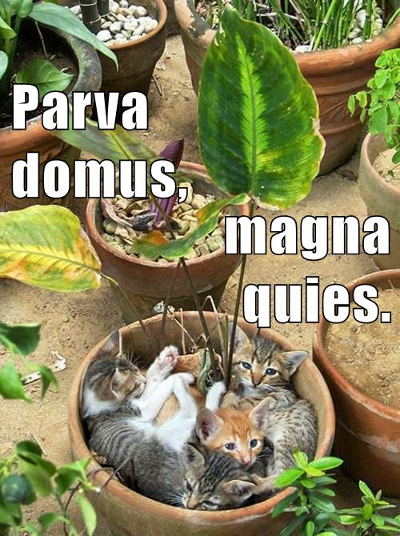
2. Parva domus, magna quies.
Small house, great peace.
PAR-va DO-mus, MAG-na QUI-es.
The nouns domus and quies are both feminine nouns, and the adjectives parva and magna are both feminine adjectives.
You can see Latin magn- in words like English "magnify," and from Latin quies we get English words like "quiescent" and "quiet."
3. Legis manus longa.
(The) hand (of the) law is long.
LE-gis MA-nus LONG-ga.
The noun manus is feminine, and the adjective longa is also feminine.
The noun legis is the genitive case form of lex, "law," so it means "(of the) law." You'll be learning more about the genitive case soon. (Latin has six cases, but don't worry: you will learn them slowly, one at a time!)
From Latin manus we get English words like "manual" and "manufacture."
4. Haec manus inimica tyrannis.
This hand (is) hostile (to) tyrants.
HAEC MA-nus i-ni-MI-ca ty-RAN-nis.
Here the feminine adjective inimica agrees with manus, and the demonstrative adjective haec is also feminine: haec manus means "this hand."
The word tyrannis is the dative plural case form of tyrannus, "tyrant," so it means "(to) tyrants."
The word inimica is literally "not-friend," in-amica; the "a" turns into an "i" after the prefix. This is the origin of the English word "inimical" and also "enemy."
5. Ex glande ardua quercus.
From (an) acorn, (a) lofty oak.
EX GLAN-de AR-du-a QUER-cus.
The word quercus is feminine, and the adjective ardua is also feminine. Although there are not a lot of rules that predict the gender of inanimate nouns, there is a rule for trees: the names of most trees in Latin are feminine nouns.
The word glans means "acorn," and glande is the ablative case; the ablative is often used after prepositions: ex glande, "out of an acorn, from an acorn."
From Latin ardu- we get English "arduous," and the word "glans" is used in medical English because it really does indeed look like an acorn.