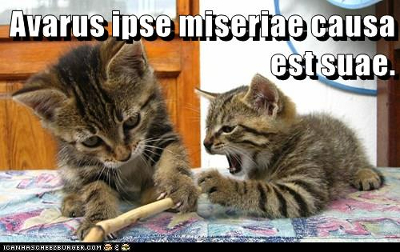
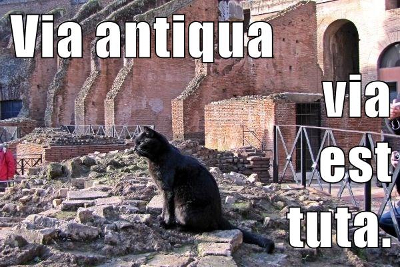
Today is a catch-up day to review any lesson(s) you missed this past week and/or to work on whatever kind of practice is most useful to you. You will find the list of lessons below, plus a random cat. I've also listed all the sayings with first-declension genitives for you to look through. They are organized into groups based on sentence structure:
genitive phrases where the genitive comes first (vitae sal = "life's salt, the spice of life"),
Vitae sal amicitia.
Invidia est animae tinea.
Tempus est vitae magister.
Dubium sapientiae initium.
Rixa rixae causa est.
Senectus vitae hiems est.
Omnis ars naturae imitatio est.
genitive phrases where the genitive comes second (corona vitae = "the crown of life, life's crown"):
Mors corona vitae.
Historia magistra vitae.
Mors ianua vitae.
Ars est simia naturae.
Pigritia est pulvinar Satanae.
Finis miseriae mors est.
Maximum remedium irae mora est.
genitive phrases that are interwoven with other words:
Faber quisque fortunaesuae est.
Incertus animus dimidium est sapientiae.
Avarus ipse miseriaecausa est suae.
two genitive phrases in one saying:
Finisirae initium est paenitentiae.
Est rota fortunae variabilis, ut rota lunae.
Vitae brevis est cursus, gloriae sempiternus.
And here are the lessons from this week; you can also see the complete list of lessonson its own page.
We're wrapping up the genitive forms of the first-declension nouns and adjectives today, and next week we'll move on to second-declension nouns and adjectives, with their genitive forms.
So, before you get started on today's sayings, review the genitive forms that you have seen earlier this week. I've put the genitive in bold, and I've also underlined the genitive phrases, and I've highlighted them in different colors so you can see where the genitive comes first and where it comes second. I honestly had not realized that I had alternated the pattern back-and-forth so systematically; it really happened by accident. I only "saw" it when I used the colored highlight.
Vitae sal amicitia.
Mors corona vitae.
Senectus vitae hiems est.
Historia magistra vitae.
Tempus est vitae magister.
Mors ianua vitae.
Dubium sapientiae initium.
Ars est simia naturae.
Rixa rixae causa est.
Pigritia est pulvinar Satanae.
Invidia est animae tinea.
Finis miseriae mors est.
Faber quisque fortunaesuae est.
Omnis ars naturae imitatio est.
Maximum remedium irae mora est.
And here are today's sayings:
1. Finis irae initium est paenitentiae.
(The) end of-anger is (the) beginning of-remorse.
finis irae i-NI-tium est paeni-TEN-tiae
You've seen finis before: Finis miseriae mors est.
You've seen irae (ira) before: Maximum remedium irae mora est.
You've seen initium before: Omne initium difficile.
The feminine noun paenitentiae is the genitive form of paenitentia, "repentence, remorse," which gives us English "penitence" and "penitentiary."
Notice how the genitive phrase initium paenitentiae wraps around the little verb est.
This finis-initium structure makes for a nice saying! As you learn more genitive forms over the next few weeks, perhaps you will invent your own finis-initium sayings.
2. Incertus animus dimidium est sapientiae.
(An) uncertain mind is half of-wisdom.
in-CER-tus A-nimus di-MI-dium est sapi-EN-tiae
You've seen the masculine incertus in its neuter form before: Praeteritum nihil, praesens instabile, futurum incertum.
The masculine noun animus has a wide range of meanings, including "the mind" and "the soul." You can read through the Latin dictionary entry to see how that works.
The neuter noun dimidium, "half," is related to another word you've seen before, medium, in the saying: Medium certum est.
You've seen sapientiae (sapientia) in a saying very similar to this one: Dubium sapientiae initium.
Once again the genitive phrase dimidium sapientiae wraps around the little verb est.
The idea is that by having doubts, you are halfway to becoming wise! You could also vary the saying this way: Incertus animus initium est sapientiae.
3. Avarus ipse miseriae causa est suae.
(A) selfish (man) is himself (the) cause of-his-own-wretchedness.
a-VA-rus ipse mi-SE-riae causa est suae
You've seen avarus before: Avarus semper est pauper.
The word ipse is an intensifying pronoun: avarus ipse, "the greedy man himself." You can see a different form of this word in the phrase "ipso facto" which is also used in English.
You've seen miseriae (miseria) before in this saying: Finis miseriae mors est.
You've also seen causa before: Rixa rixae causa est.
And you've also seen suae (sua) before: Faber quisque fortunae suae est.
Notice how this time the genitive noun and adjective, miseriae suae, wrap around the noun and verb: miseriae causa est suae.
4. Est rota fortunae variabilis, ut rota lunae.
(The) wheel of-fortune is changeable, like (the) wheel of-(the)-moon.
est rota for-TU-nae vari-AB-ilis, ut rota lunae
The feminine noun rota, "wheel," is what you see in the English verb "rotate."
You've seen fortunae (fortuna) before: Fortuna caeca est.
The feminine adjective variabilis, "changing, variable," gives us English "variable."
The word ut has many functions in Latin; here it is being used for comparison: "like, as."
The feminine noun lunae is the genitive of luna, "moon," which you can see in English "lunar" and also "lunatic."
This is a rhyming medieval proverb: fortunae-lunae. You can read more about the proverbial Rota Fortunae at Wikipedia.
5. Vitae brevis est cursus, gloriae sempiternus.
(The) course of-life is brief, (the course) of-glory (is) eternal.
vitae brevis est cursus, GLO-riae sempi-TER-nus
You've seen vitae (vita) many times now!
You've seen masculine brevis in its neuter form, breve, in this saying: Tempus breve est.
The masculine noun cursus, "course," is from the verb currere, "to run." This is the origin of English "course" and also "cursive."
You've seen gloriae (gloria) before in this saying: gloria: Ubi pericula, ibi gloria.
The masculine adjective sempiternus, "eternal," gives us English "sempiternal."
Notice how this saying is based on parallels: vitae is parallel with gloriae while brevis is parallel with sempiternus. When a Latin statement has this type of parallel structure, it can leave out the repeated words that are part of the parallelism: Vitae brevis est cursus, gloriae sempiternus (est cursus).
The focus for today's lesson is more genitive forms of first-declension words. I'll give you a sneak preview of the genitive phrases in today's sayings: maybe you can guess what they are going to say based on these clues!
animaetinea: the moth of the soul
finismiseriae: misery's end
faberfortunaesuae: the maker of his own fortune
naturaeimitatio: the imitation of nature
remediumirae: anger's remedy
As you've seen before, there is no fixed word order: sometimes the genitive comes first in the phrase, and sometimes it comes second. It's just a matter of style, depending on the sound play in the sentence and what the speaker wants to emphasize.
So, here are today's sayings:
1. Invidia est animae tinea.
Envy is (the) moth (of the) soul.
in-VI-dia est A-nimae TI-nea
The feminine noun invidia is one you have seen before: Est vipera invidia. The feminine noun animae is the genitive of anima, which you have seen before: Nonne anima plus est quam esca?
The feminine noun tinea is "moth," more specifically the gnawing moth-worm that eats clothes. Latin tinea can also refer to the gnawing worm that eats books, i.e. bookworms. In English, "tinea" refers to ringworm (but as doctors now know, it's not really a worm; it's a fungus).
So, the key idea here is that envy is something like a moth or bookworm that gets inside your soul and gnaws and gnaws! Envy slowly destroys your beautiful soul just as moths destroy beautiful clothes and as bookworms destroy beautiful books.
2. Finis miseriae mors est.
Death is (the) end of-misery.
finis mi-SE-riae mors est
The masculine noun finis, "end, limit, boundary," give us English "finish" and "final." The feminine noun miseriae is the genitive of miseria, "wretchedness," a noun formed from an adjective, misera, that you have seen before: Omnis est misera servitus. This is where we get English "misery." The feminine noun mors is one you have seen before: Mors corona vitae.
Compare this English proverb, "A dead mouse feels no cold."
3. Faber quisque fortunae suae est.
Everyone is (the) maker of-his-own luck.
faber quisque for-TU-nae suae est
The masculine noun faber, "maker," is at the root of English "fabricate." The masculine pronoun quisque means "each person, everyone." Don't worry: there is a feminine "everybody" too; you'll learn all the forms of this pronoun later. The feminine noun fortunae is the genitive of fortuna, which you have seen before: Fortuna caeca est.
The feminine adjective suae is the genitive of sua, "one's own."
This is the first time you have seen both a noun and an adjective in the genitive: fortuna sua is nominative, and fortunae suae is genitive. Both the noun and the adjective have a genitive ending. Notice also that the phrase faber fortunae suae is broken up: the words are not next to each other! But that's the freedom of Latin word order. Words can be in the same phrase but not necessarily next to each other. In English word order, this sentence would be: Quisque est faber suae fortunae.
This famous Latin saying is attributed to Appius Claudius Caecus, a famous politician and writer of the Roman Republic; he died in 279 B.C.E.
Latin fortuna means both "fortune" and "luck" in English, and "luck" fits better for this saying, which boldly claims that you actually make your own luck!
4. Omnis ars naturae imitatio est.
Every art is (an) imitation of-nature.
omnis ars na-TU-rae imi-TA-tio est
You have seen the feminine adjective omnis before: Omnis est misera servitus.
You saw the feminine noun ars yesterday: Ars est simia naturae.
The feminine noun naturae is the genitive of natura, which you have also seen in this saying: Habitus est altera natura.
The feminine noun imitatio, "imitation, copy," gives us English "imitation."
This saying comes from one of the letters of Seneca (the Younger), a famous writer who lived under the emperors Claudius and Nero; he was forced to commit suicide by Nero. Find out more at Wikipedia.
5. Maximum remedium irae mora est.
Delay is anger's most effective cure.
MA-ximum re-ME-dium irae mora est
The neuter adjective maximum is one that you have seen in its masculine and feminine forms before: Hodie nullus, cras maximus and Mea culpa, mea culpa, mea maxima culpa. The neuter noun remedium, "remedy, cure, antidote," gives us English "remedy." The feminine noun irae, "anger, rage," is the source of English "ire" and also "irate."
The feminine noun mora, "delay, pause, stop," is at the root of English "moratorium."
These words also come from Seneca, in his famous essay called De Ira, "About Anger," which has its own Wikipedia article.
So, the next time you are angry, just take a deep breath, PAUSE, and think about the Stoic philosopher Seneca. Hopefully that delay will help dissipate your anger!
The focus for today's lesson is once again the genitive case of words in the first declension. What I want to talk about today is how every word has a stem, and you add different endings depending on the case. The endings also change based on whether the word is singular or plural; we'll get to plural nouns and adjectives later.
So, for the first declension noun vita, the stem is vit-.
The nominative ending is -a, so vit- plus -a gives you vita.
The genitive ending is -ae, so vit- plus -ae gives you vitae.
You will see another vitae saying today, plus sayings with other genitive nouns. So, keep an eye out for the -ae ending, making sure you understand how it expresses the idea of English "of" of apostrophe-s. Each genitive noun is part of a phrase, so make sure you see the whole phrase that gives the genitive its meaning in context.
Here are today's proverbs:
1. Dubium sapientiae initium.
Doubt is the beginning of-wisdom.
DU-bium sapi-EN-tiae i-NI-tium
The noun dubium means "doubt," and it is the origin of the English word "doubt" also.
The noun sapientiae is the genitive form of sapientia, which you have seen in two sayings already: Sapientia potentia and Sapientia felicitas. The noun initium is also one you've seen before: Omne initium difficile.
The idea is that being uncertain about something is the key to learning something new: uncertainty makes you ask questions, and that then leads to wisdom.
2. Mors ianua vitae.
Death is (the) door of-life.
mors JA-nua vitae
The noun mors is one you saw yesterday: Mors corona vitae.
The noun ianua, or janua, "door, entry, entrance" gives us English "janitor."
The noun vitae is the genitive form of vita, as you learned in yesterday's sayings. The phrase is ianua vitae, "the door of life."
This saying comes from Christian Latin, expressing the idea that there is life-after-death, and so it is often found on funeral monuments (here's an example).
3. Ars est simia naturae.
Art is nature's monkey.
ars est SI-mia na-TU-rae
The noun ars, "art" is the origin of English "art." You will learn later that the stem of ars is art- which makes it easier to see how it could be the origin of English "art."
The noun simia, "ape, monkey" gives us English "simian." Just like in English, where "to ape" means "to imitate," Latin simia conveys the idea of an "imitator."
The noun naturae is the genitive form of natura, which you have seen already in this saying: Habitus est altera natura. The phrase is simia naturae, "nature's monkey."
The idea in this saying is that art is "just" an imitator; all art can do is to copy nature, and to do so imperfectly.
4. Rixa rixae causa est.
(An) argument is (the) cause of-(an)-argument.
rixa rixae causa est
The noun rixa means "argument, quarrel," and its genitive form is rixae.
The noun causa, "cause, reason," is the origin of English "cause." The phrase is rixae causa, "the cause of an argument."
Instead of repeating the word "argument" in the English, you could also translate it in English this way: "One quarrel is the cause of another" or "One quarrel leads to another."
5. Pigritia est pulvinar Satanae.
Laziness is Satan's pillow.
pi-GRI-tia est pul-VI-nar Sa-tanae
The noun pigritia, "laziness" is from the adjective piger (masculine) / pigra (feminine), which means "lazy."
The noun pulvinar, "pillow, cushion, sofa," is used in medical English; the pulvinar is part of the brain. The Latin word is also the origin of English "pillow."
The name Satanae is the genitive form of the nominative Satanas, "Satan," so pulvinar Satanae means "Satan's pillow."
Do you see how this nominative form looks different from the other first-declension nouns you've seen so far? That's because it is a masculine noun in the first declension, which is unusual but not impossible, and the word "Satan" is even more unusual because it is a Hebrew word that was used in Greek and then adopted by Christian Latin, and also by English; more about the etymology of English "Satan."
The Latin pulvinar referred to the comfortable cushions on which guests sat at a banquet, which is the idea here: when you are lazy, you are giving Satan an invitation that he will be glad to accept. Compare the English proverb: "Idle hands are the Devil's workshop."
The focus for today's lesson is the genitive case! Yes, something new! We have been working on the nominative case for several weeks, and now for the next 3 weeks, the focus will be on the genitive case.
The genitive case is similar to "of" in English, but without using an extra word. Instead, you just change the form of the word, and it means "of" that word.
vita = life. vitae = of-life.
You can actually see the remnants of the genitive case in the English apostrophe-s. The genitive ending in Old English was -es and over time it turned into apostrophe-s. The result is that in English was have a choice: we can use the genitive case with apostrophe-s OR we can use the preposition "of" — "Brenda's book" is the same as "the book of Brenda." In Latin, however, there is not a preposition that means "of" like there is in English; instead, you use the genitive case to express that idea in Latin.
Unlike the nominative nouns and adjectives that you have seen before, which stand on their own, the genitive word does not stand on its own. Instead, it is connected to some other word in the sentence, forming a phrase. For example, in the first saying today, you will see the phrase vitae sal, "the salt of-life" or "life's salt."
And remember: Latin word order is free! So sometimes the genitive word might come first in its phrase, but sometimes it might come second, as in CV, which stands for curriculum vitae, "the course of-life."
Tomorrow I'll have more to say about exactly how to put Latin words into the genitive case. For now, just focus on the idea that vitae means of-life. You will see vitae in each of today's sayings:
1. Vitae sal amicitia.
Friendship (is the) salt of-life / life's salt.
vitae sal ami-CI-tia
The noun vitae is the genitive form of vita, so it means "of life," and vitae sal means "salt of life." Compare the English phrase, "the spice of life."
The noun sal "salt" is related to the English word "salt" because both are from Indo-European séh₂ls. You also see the Latin root in English words like "salary" and "saline."
The noun amicitia, "friendship," is derived from amicus, "friend."
You can see this Latin saying inscribed on a building in Kyoto, Japan (!), along with several other famous Latin sayings.
2. Mors corona vitae.
Death (is the) crown of-life / life's crown.
mors co-RO-na vitae
You've seen the noun mors already in this saying: Aequa mors est.
The noun corona, "crown," actually gives us the word "crown" in English, along with "corona" and "coronation."
The phrase in this saying is corona vitae, "life's crown," with the genitive coming after the noun that it is modifying.
Compare the English phrase "a crowning achievement." The idea is that death is the crown, i.e. the crowning achievement, of life.
3. Senectus vitae hiems est.
Old age is (the) winter of-life / life's winter.
se-NEC-tus vitae hiems est
The noun senectus, "old age," is related to a word you have learned already, senex, which you saw in this saying: Bis puer est senex.
The noun hiems, "winter," is at the origin of the English word "hibernate" (via the Latin adjective hibernus). This word is also related to "Himalaya," because in Sanskrit the word for snow is hima, a cousin of Latin hiems (Sanskrit is an Indo-European language like both Latin and English.)
The phrase in this saying is "vitae hiems," "the winter of-life," with the genitive coming before the noun that it is modifying.
In this saying, a human life is mapped onto a calendar, with life beginning in spring, passing through summer and autumn, and then reading its ending in winter.
4. Historia magistra vitae.
History (is the) teacher of-life / life's teacher.
his-TO-ria ma-GIS-tra vitae
The noun historia gives us English "history," and the word goes back to Greek historia.
The noun magistra means "teacher," and it is feminine in form. That is because historia is a feminine noun. For the masculine form of "teacher," magister, see the next saying!
The phrase in this saying is magistra vitae, "life's teacher." The genitive comes second in the phrase.
The idea is that to live one's life in the present, you need to learn from life in the past, that is, from history. So, let history be your teacher!
5. Tempus est vitae magister.
Time (is the) teacher of-life.
tempus est vitae ma-GIS-ter
You've seen the noun tempus in several sayings already; for example: Tempus breve est.
The word magister, "teacher," is masculine, in contrast to magister, feminine. You've seen magister in several sayings already: Optimus magister bonus liber.
The phrase in this saying is vitae magister, "life's teacher." Compare the word order in the previous saying: magistra vitae. The word order is just a matter of style! It does not change the meaning.
So, the idea again is that as time goes by, you accumulate experiences, and you should learn from those experiences. Let time be your teacher!
The focus for today's lesson is the first-declension nouns and adjectives, the ones that end in -a.
What I want to emphasize now is that these words are the nominative case form. There are five different cases in Latin — nominative, genitive, accusative, dative, and ablative — and you will be learning all of those cases one by one. Tomorrow, in fact, you will start learning the genitive case, which is why I wanted to emphasize the nominative case today.
The nominative case is the form of the word that you will find in the dictionary. In a sentence, there is only one thing that a nominative word can do: it is the subjectof the sentence and/or it agrees with the subject as the predicate. For example:
Roma aeterna est.
The word Roma is the nominative subject, and aeterna, agreeing with Roma, is the predicate. (That is a loose, traditional way of using the word predicate; for the more strict use of the term "predicate" in linguistics, see Wikipedia: Predicate.)
So, before we move on to the genitive case tomorrow, here are some sayings where you can practice the nominative case one more time, learning some new first-declension nouns and adjectives that end in -a:
1. Via antiqua via est tuta. (The) ancient way is (the) safe way.
via an-TI-qua via est tuta
The noun via means "path, road, way," and has been adopted into English as "via." You can also see it in compounds like "viaduct" and "deviate."
The adjective antiqua means "old, ancient," as in English "antique." In English, "antique" can have the sense of outmoded, outdated, even useless, but in Latin, the word antiqua has strongly positively associations, as you can see if you read this Latin dictionary entry.
You have seen the adjective tuta in its masculine form before: Locus medius tutus est. Notice how the noun phrase, via tuta, wraps around the verb: via est tuta.
The idea is that an old, well-established road will safely lead you to your destination, as it has led many others before you. Metaphorically it means that the "old way" is the best way to get anything done.
2. Patria est ubicumque est bene. (Your) fatherland is wherever (it) is good.
PA-tria est ubi-CUM-que est bene
You have seen patria in this saying: Patria mea totus mundus est.
The adverb ubicumque means "everywhere," and it is a compound of the word ubi, "where," which you have seen in many sayings so far, like Ubi veritas, Deus ibi est.
The adverb bene, "well," is related to the word for "good," bonus. You can see Latin bene in many English words like "benefit" and "benevolence."
This is another one of those cosmopolitan sayings which reject the narrow idea that your homeland is a matter of birth. Instead, it is a matter of choice: wherever things go well for you, that can be your homeland.
3. Longa est vita si plena est. Long is life if (the life) is full.
longa est vita si plena est
You've seen longa before in this saying: Legis manus longa.
You know the word si from this saying: Si satis est, multum est.
The adjective plena, "full," shows up in English "plenty" and "plenary."
Compare the English idiom, "to lead a full life."
4. Nonne anima plus est quam esca? Isn't life more than food?
nonne A-nima plus est quam esca
The word nonne introduces a question to which the expected answer is "yes." Latin non means "no" or "not," while -ne is a question marker. So in Latin, just like in English, the word "not" can be used to ask a question expecting a positive answer: Is not life more than food?
The noun anima means "soul, spirit," and it also means "the breath of life, life." You can see this Latin root in English "animate" (as opposed to "inanimate").
The word plus, "more," has been adopted into English as "plus" (and "minus" is also a Latin word)
You've seen quam used for expressing a comparison in this saying: Melior est res quam spes. That is the role of quam in this sentence also: plus quam, "more than."
The noun esca, "food," is related to the verb edere, "to eat." You can see this Latin root in English "escarole" and "esculent."
The implication is that life is more than food, i.e. more than just material substance; instead, life is about the life of the soul, anima, not just esca.
5. Mea culpa, mea culpa, mea maxima culpa. My fault, my fault, my greatest fault.
mea culpa, mea culpa, mea MAX-ima culpa
You've seen mea in these sayings: Dominus illuminatio mea and Ventus est vita mea.
The noun culpa, "fault, crime, mistake" shows up in English "culpable." We also use the Latin phrase mea culpa in English, "(it's) my fault."
You've seen maxima in its masculine form before: Hodie nullus, cras maximus.
This particular formula is part of the Latin rite of confession in the Catholic Church; you can find out more at Wikipedia: Mea culpa.