Here's this week's catch-up post to help you review any lesson(s) you missed this past week and/or to work on whatever kind of practice is most useful to you as you keep on getting familiar with the ablative case, along with this new use of the accusative case.
So, here are the lessons from this week, plus previous weeks, and you'll find the review slideshow before:
This is the slideshow with all the sayings from the week. Read out loud, first with the English to remind you of the vocabulary... and then with the cat!
I also made a printable crossword PDF with this week's sayings as the prompts; screenshots below.
The focus for today's lesson is practice with the first declension, based on what you have learned this week. In today's sayings you'll see the short -a ending of the nominative case, the long -a (ā) ending of the ablative case with prepositions, and the -am ending of the accusative that can also be used with prepositions. (Next week we'll move on to the ablative ending for the 2nd declension!)
In order to review some vocabulary first, here is a little slideshow (with cats) of the words you have seen before:
And here are today's proverbs:
1. Epistola non erubescit.
(A) letter doesn't blush.
e-PIS-tola non eru-BES-cit.
The Latin noun epistola, "letter, correspondence," gives us English "epistle" and "epistolary." This was originally a Greek word ἐπιστολή(epistole) adopted by the Romans; you can see it spelled in Latin in the Greek way, epistola, and also as epistula.
The case of epistola is nominative; it is the subject of the verb.
The idea is that you might be bold to say things in writing than you would say in person. This saying dates back to the time of written letters (it is found in the letters of Cicero!), but of course it still holds true, perhasp even more so, in the era of social media and texting.
2. Ex auricula asinum.
From (the) ear (you recognize the) donkey.
ex au-RI-cula A-sinum.
The word auricula (auriculā) is the ablative form of the noun auricula, "ear, little ear." This is a diminutive form of the word auris, "ear," although obviously it is ironic: the donkey's ears are anything but little!
The word asinum is the accusative form of the noun asinus, which you have seen before. Although there is no verb in this saying, the use of the accusative case here lets you know that a verb is implied, with asinum as the object of that implied verb.
The idea is that while a donkey might pretend to not be a donkey, the ears will give him away. This saying is connected to the Aesopic fable of the donkey in the lion skin: while he wore the loin skin, everyone was afraid of him and he could graze wherever he wanted, but when someone noticed the ears sticking out from under the lion skin, they realized the lion was just a donkey (illustrations here).
3. Pro perca scorpium.
In-place-of (a) fish, (a) scorpion.
pro perca SCOR-pium.
The word perca (percā) is the ablative form of the noun perca, "perch," i.e. the fish called perch. It is in the ablative case here with the preposition pro, "in place of, instead of, in exchange for, for." You might recognize this Laitn preposition from the phrase pro bono.
The word scorpium is the accusative form of the noun scorpius, which you have seen before. As in the previous saying, there is no verb, but the use of the accusative case here lets you know that there is an implied verb, and scorpium is the object of that implied verb. The idea, of course, is that a fish is something nice, while a scorpion is not. Compare a similar saying in the Gospel of Matthew: "what man is there of you, whom if his son ask bread, will he give him a stone? or if he ask a fish, will he give him a serpent?"
4. Fugit hora sine mora.
Time flies without delay.
fugit hora sine mora.
The word mora (morā) is the ablative form of the noun mora, which you have seen before. It is in the ablative case with the preposition sine, "without." You might know that Latin preposition from the phrase sine qua non which is sometimes used in English.
This is another one of those "time flies" sayings that you have seen before, and this one rhymes: hora-mora. The use of rhyme is a clue that this is a medieval Latin proverb, not classical.
5. Ante tubam trepidat.
(Someone) trembles before (the) trumpet.
ante tubam TRE-pidat.
The word tubam is the accusative form of the noun tuba, "trumpet," and especially a trumpet used in war. From Latin tuba we get English "tuba" of course.
The preposition ante takes the accusative case, and you might know this word already from "antebellum," which is Latin ante bellum, "before the war." We also use this word in English as "ante" as when you "ante up" before each round of a poker game, putting money into the pot.
The verb trepidat, "trembles, feels fear," can be seen in English "trepidation" and also in the negated form, "intrepid."
The idea is that soldiers should be intrepid, but this saying makes fun of a soldier who is quaking with fear even before the war-trumpet has sounded.
The focus for today's lesson is something new: prepositions that take the accusative case instead of the ablative. So far, all the prepositions you have looked at use ablative case, but there are a few prepositions that take the accusative case, often with the idea of motion towards. These are the prepositions you will see in today's sayings:
ad + accusative: to, towards
extra + accusative: beyond, outside
super + accusative: upon, on
You've actually seen the word extra before — Est avis in dextra melior quam quattuor extra. — because it can be used as an adverb as well as being used as a preposition.
You've also see ad before, used to create compound verbs; for example: ad-spicit, "looks at, looks towards." You'll actually see lots of prepositions doing double-duty like that, being used as adverbs and also to form compound words.
To get ready, here is a little slideshow (with cats) of the words you have seen before:
And here are today's proverbs:
1. Asinus ad lyram.
(A) donkey towards (a) lyre.
A-sinus ad lyram.
The word lyram is the accusative form of the noun lyra, which gives us "lyre" in English. (The word is originally Greek — the letter y is the clue, because y is not a letter in the Roman alphabet, but it is the Greek letter upsilon.)
This saying is used to make fun of someone who is doing something inappropriate, like a donkey who's headed towards a lyre, as if a donkey could play the lyre! There are a lot of Latin sayings that make fun of donkeys who pretend to be smart and sophisticated, but who are really just donkeys. You've seen one of these mocking proverbs before: Illiteratus rex est asinus coronatus. A donkey gets on a throne, a donkey grabs a lyre: either way, he's still just a donkey.
2. Ardua ad gloriam via.
(The) road to glory (is) steep.
AR-dua ad GLO-riam via.
You know all the words in this saying already! The word gloriam is the accusative form of the noun gloria.
The idea is that the path to glory is difficult, and even dangerous — a steep, uphill climb — but that is the way to win glory.
3. Ut piscis extra aquam.
Like (a) fish out-of water.
ut piscis extra aquam.
You also know all the words in this saying.
The word aquam is the accusative form of the noun aqua.
We use this same saying in English: "Like a fish out of water." In English "out of water" is ambiguous (it can mean lacking water, having run out of water), but the Latin is more clear: like a fish outside of water.
4. Nihil novum super terram.
(There is) nothing new upon (the) earth.
nihil novum super terram.
You haven't seen the neuter adjective novum before, but you have seen the masculine novus and the feminine nova.
The word terram is the accusative form of the noun terra.
Compare the English saying, "There's nothing new under the sun," which actually comes from a different Latin saying found in the Book of Ecclesiastes: Nihil sub sole novum.
5. Vade ad formicam, o piger!
Go to (the) ant, O lazy (person)!
vade ad for-MI-cam, o piger!
The word formicam is the accusative form of the noun formica, "ant." This gives us "formic acid" in English because it is an acid that occurs naturally in ants who spray this acid to defend their nests. This is also the -form that you see in "chloroform."
The word o is used to address somone in Latin, just like "O" in English; this form of address is called the "vocative," which you will learn more about later. (In English, this vocative use of "O" is usually capitalized, unlike "oh," which is an interjection.)
This is from the Biblical Book of Proverbs; the idea is that the ant is hard-working, so someone who is lazy should look to the ant and imitate what the ant does instead. Here is the complete Bible verse: Vade ad formicam, o piger, et considera vias eius, et disce sapientiam, "Go to the ant, thou sluggard; consider her ways, and be wise."
It's time for another vocabulary review, which again takes the form of a slideshow that you can use as a quiz and/or as a tool for review. After all, repetitio mater memoriae, as you learned last week. Vocabulary is the biggest challenge in learning a new language, so the more you can review vocabulary, the better! Grammar is really not the challenge; it's all those new words!
So, below is this week's vocabulary review; the slides have the English translations, plus links back to the original posts: full-size show. You can use this as a quiz, filling in the blank based on the English prompt. Alternatively, you can just rely on the other slides, reading each saying out loud, both with and without the English to help you. And hopefully seeing the cats will help you remember the sayings too!
If you want to do even more reviewing (you cannot review too much!), here are the review slideshows from Week 24, Week 23 and Week 22. The more you can repeat, the more you will remember!
And... here's a random cat (I recently updated the randomizer, so there are something like 500 cats in there now!)
The focus for today's lesson is again the use of the ablative case with prepositions, focusing on first-declension nouns and adjectives. You've seen all these prepositions before, but here's a quick review:
in: in, insde
ex: out, out from
sine: without
The ablative ending you need for the 1st-declension nouns and adjectives is the long -a (ā).
And here is a little slideshow (with cats) of the words you have seen before; now that your vocabulary is getting bigger and bigger, there are fewer new words for each set of new sayings.
And here are today's proverbs:
1. Simia in purpura.
(A) monkey in purple (robes).
SI-mia in PUR-pura.
The word purpura (purpurā) is the ablative form of the noun purpura gives us English "purple." This adjective is being used as a noun here, "(royal) purple (robes)."
The idea is that if you give regal honors to an unworthy person, that person is still just as unworthy as they were before. Here's a variation: Simia est simia, etiam si purpura vestiatur, "A monkey is a monkey, even if dressed in purple."
2. Ex musca elephantem.
(Making an) elephant out-of (a) fly.
ex musca ele-PHAN-tem.
You know all these words already!
The word musca (muscā) is the ablative form of the noun musca.
The word elephantem is the accusative form of the 3rd-declension noun, elephas.
Compare the English saying "making a mountain out of a molehill."
Notice that there is no explicit verb, but the fact that you have a noun in the accusative case means that you have an implied verb, and elephantem is the object of that verb (making, creating, fashioning, etc.).
3. Ars sine scientia nihil.
Technique without knowledge (is) nothing.
ars sine sci-EN-tia nihil.
You also know all these words too.
The word scientia (scientiā) is the ablative form of the noun scientia.
The Latin word ars has a wide range of meaning; "technique" is probably the best choice in this context. You can explore the many meanings of ars here.
This saying is famously associated wtih the Gothic architect Jean Mignot, who meant that the practice of masonry was useless without a knowledge of geometry.
4. Sine iustitia nulla libertas.
Without justice (there is) no freedom.
sine ius-TI-tia nulla li-BER-tas.
Yet another saying where you have seen all the words already!
The word iustitia (iustitiā) is the ablative form of the noun iustitia.
The noun libertas is a feminine noun of the 3rd declension, so it has a feminine adjective: nulla.
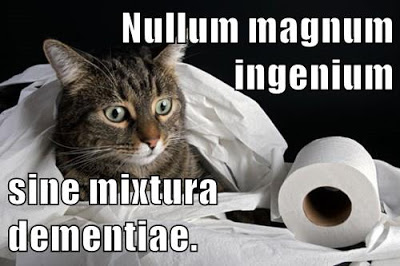
5. Nullum magnum ingenium sine mixtura dementiae.
(There is) no great genius without (an) admixture of-insanity.
nullum magnum in-GE-nium sine mix-TU-ra de-MEN-tiae.
The word mixtura (mixturā) is the ablative form of the noun mixtura, which gives us English "mixture, admixture."
The neuter noun ingenium, "intelligence, ability, genius," is new to you, but you've seen a related adjective: ingeniosus, as in English "ingenious." Because ingenium is a neuter noun, the adjectives nullum and magnum are also neuter.
The word dementiae is the genitive form of the noun dementia, a Latin word we use in English, "dementia." The root is men (ment-), "mind," and it means de-mentia, "away-from mind," as in the English expression "out of one's mind."
This saying comes from the essay De Tranquillitate by the Roman philosopher Seneca. paraphrasing Aristotle in Latin.
The focus for today's lesson is more practice with prepositions that take the ablative case, which means an -a (long -ā) ending for 1st-declension nouns and adjectives.
There's a new preposition that you'll see today, and it needs a bit of explanation. The preposition is cum, which means "with." You may already be familiar with this word in the Latin phrase cum laude, 'with praise" (-e is the 3rd-declension ablative ending; you'll learn that later), and also in the phrases magna cum laude, "with great praise," and summa cum laude, "with highest praise."
But you might remember that you already saw the word cum in Latin meaning "when," as in the saying: Numquam minus solus quam cum solus, "Never less alone than when (cum) alone."
So, just like in English, there are homonyms in Latin, more specifically homographs: word pairs that are spelled the same but which are actually two different words. Tin ENglish, there are "bats" that fly at night, and there are "bats" in a baseball game, for example, and you "can" do something, but you might also buy soup in a "can." Bells "ring," and you can wear a "ring" on your finger. On and on! There are quite a few homonyms in Latin too, but not as many as in English.
This means that when you see the Latin word cum it might be the preposition,"with," or it might be the conjunction "when." You can only tell the difference from context, so just remember: if cum is a preposition, there will be something in the ablative case to complete the prepositional phrase.
That might be confusing now, and English homonyms can be confusing too, but in the same way that you don't usually get confused by English homonyms, the same will be true of Latin over time too!
To get ready for today's sayings, here is a little slideshow (with cats) of the words you have seen before, and there are a lot of familiar words today:
And here are today's proverbs:
1. Lupus in fabula.
(A) wolf in (the) conversation.
lupus in FA-bula.
The word fabula (fabulā) is the ablative case of the noun fabula, "story, talk, conversation," which is the origin of English "fable" and also "confab."
This Latin saying is equivalent to the English saying, "Speak of the devil (and he will appear)." In Latin, the lupus takes the place of the devil. You can find out more here: Lupus in Fabula: How to Speak of the Devil in Latin.
2. Ex luna scientia.
From (the) moon, knowledge.
ex luna sci-EN-tia.
The word luna (lunā) is the ablative case of the noun luna, which you have seen before.
This was the motto of the Apollo 13 mission to the moon; for more, see Wikipedia: Apollo 13.
3. Nihil fit sine causa.
Nothing happens without (a) cause.
nihil fit sine causa.
The word causa (causā) is the ablative case of the noun causa, which you have seen before.
4. Cum Minerva manum quoque move.
With Minerva, move (your) hand also.
cum Mi-NER-va manum quoque move.
The word Minerva (Minervā) is the ablative case of the noun Minerva, which you have seen before, and it is being used here with the preposition cum, "with."
The adverb quoque means "too, also, in addition."
To understand this proverb, you need to know the Aesop's fable that it comes from: during a shipwreck, an Athenian finds himself drowning, so he prays to Minerva (Athena) to save him because Athena was the patron goddess of Athena; another passenger swims by the Athenian, hears him praying, and rebukes him with these words, "In addition to praying, you better start swimming!" In other words, god helps them that help themselves. You better make an effort yourself together with whatever divine help you might receive.
5. Est avis in dextra melior quam quattuor extra.
(A) bird in (the) right (hand) is better than four outside (the hand).
est avis in dextra ME-lior quam QUAT-tuor extra.
The word dextra (dextrā) is the ablative case of the adjective, dextra, which means "right" (as in "not left"). The adjective is being used substantively as a noun, "right (hand)."
The adverb extra means "outside, beyond," and of course we use the word "extra" in English also.
The number quattuor, "four," is from the same Indo-European root as the English word. You can see the Latin and English numbers together with other Indo-European numbers here at Wikipedia: Indo-European vocabulary.
Compare the English saying, "A bird in the hand is worth two in the bush."
This Latin saying rhymes (dextra...extra) which shows that it is a medieval saying; medieval poems and proverbs are full of rhymes, unlike classical Latin which uses quantitative meter based on vowel length rather than rhyme. If you are curious about all that, you can find out more at Wikipedia: Latin prosody.