The focus for today's lesson is more feminine nouns and adjectives, so let's start by reviewing the sayings you've seen so far that feature only feminine nouns and adjectives, grouped by the different word patterns:
NOUN IS NOUN:
Scientia potentia.
Sapientia potentia.
Sapientia felicitas.
Innocentia eloquentia.
Eloquentia sagitta.
Est vipera invidia.
Peregrinatio vita est.
NOUN IS ADJECTIVE:
Paupertas ingeniosa.
Mendax fama.
Amara est veritas.
Roma aeterna est.
Fortuna caeca est.
Aequa mors est.
Jacta alea est.
NOUN IS ADJECTIVE-NOUN:
Spes ultima dea.
WHEN/WHILE NOUN IS, NOUN IS.
Dum vita est, spes est.
Now, here are some more sayings with only feminine nouns and adjectives:
1. Mediocritas optima est. Moderation is best.
Me-di-O-cri-tas OP-ti-ma EST.
Latin mediocritas means "being in the middle, moderation," without any of the negative connotations of the English word "mediocrity." Just the opposite: mediocritas is the best!
Latin optima, "best," can be seen in English words like "optimum," "optimal," etc.
Compare a similar phrase: aurea mediocritas, "the golden mean." You can find out more at Wikipedia: Golden mean.
2. Omnis est misera servitus. All slavery is wretched.
OM-nis EST MI-se-ra SER-vi-tus.
Latin omnis is an adjective meaning "all, every," as in English omni- words like "omnivore," "omnivorous," etc.
Latin misera, "wretched, sad," gives us English "miserable."
Latin servitus can mean "slavery" or "servitude," as the Latin noun servus can mean "slave" or "servant."
This is a new sentence pattern: the noun phrase omnis servitus, which is the subject of the sentence, wraps around the predicate: est misera. This "wrap-around" style of Latin sentence is very common, not just in poetry, but also in prose.
Latin furtiva, "furtive, stealthy," is an adjective derived from the Latin word fur, "thief."
Venus is the name of the Roman goddess of love, and the word Venus can also mean "love." You can find out more about the goddess Venus at Wikipedia. The names of other Roman gods and goddesses can be used as nouns in this way: Mars is war, Bacchus is wine, Ceres is bread, etc.
Latin dulcis, "sweet," gives us the English word "dulcet," although English "dulcet" refers only to sweet sounds, like the sound of someone's voice. Latin dulcis, however, can be used for sweet tastes, sounds, feelings, just like English "sweet." The form dulcior is comparative: "sweeter." Venus is always sweet, but furtiva Venus is sweeter.
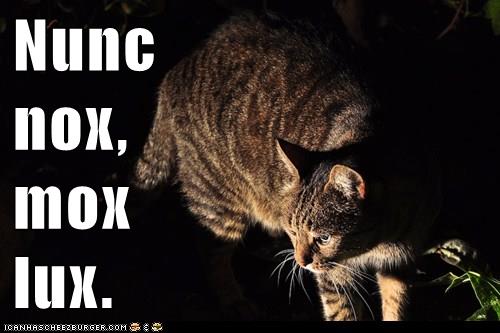
4. Nunc nox, mox lux. Now (it is) night, soon (it will be) day.
NUNC NOX, MOX LUX.
Latin nunc means "now," and both Latin nunc and English "now" are from the same Indo-European root: nu.
Latin nox, "night," has as its stem noct- which you can see in the English word "nocturnal."
Latin mox means "soon," and the way mox rhymes with nox is part of the stylistic charm of this saying.
Latin lux, "light," has as its stem luc- which you can see in the English word "lucid."
5. Quam dulcis libertas! How sweet (is) liberty!
QUAM DUL-cis li-BER-tas!
The Latin word quam, "how," can be used in exclamations, just like English "how."
Latin libertas is a noun formed from the adjective liber, "free," and gives us English "liberty."
Now that you know this sentence pattern, you can make up all kinds of exclamations:
Quam dulcis Venus!
Quam dulcis vita!
Quam misera servitus!
Quam amara servitus!
Quam mendax fama!
So, feel free to start composing your own little Latin sentences, and if you have written something and would like me to check it, just send me an email. It's fun to get a Latin email!
For Christmas, I thought I would share a Latin holiday song from my personal favorite Christmas movie, Joyeux Noel, about the Christmas truce during World War I (more about the Christmas Truce at Wikipedia). The Latin song "Adeste, fideles" begins at about 6 minutes 20 seconds into this clip I found at YouTube:
Here are the Latin words:
Ad-ES-te fi-DE-les, Be present, (you) faithful (people),
Ve-NI-te, a-do-RE-mus DO-mi-num. Come, let us adore (the) Lord.
The singer here uses Church pronunciation: for "laeti," he says "leti," and also "v" instead of "w," etc. At the end he sounds like he is singing "adoramus," "we are adoring," instead of "adoremus," "let us adore."
Finally, here are some Christmas LOLCats for your enjoyment: Merry Christmas!
The focus for today's lesson is more sayings with feminine nouns and adjectives. So, you might want to take a quick look again at the information about Latin gender in the previous lesson. We'll spend another couple of days looking at feminine nouns and adjectives, and then we'll switch to the masculine and neuter genders.
So, here are today's sayings:
1. Mendax fama.
Rumor (is a) liar.
MEN-dax FA-ma.
The Latin adjective mendax means "false, untrue, lying," and it can also be used substantively to mean "a liar" (a substantive adjective is an adjective used as a noun; this is very common in Latin, and you'll learn more about that later). From this Latin root we get the English word "mendacious." Latin fama is from the verbal root fa- meaning "speak, say" (an "infant" is someone who is in-fans, not able to speak). So fama can mean whatever people are saying, but it can also have the negative sense of rumor, as in this proverb. It can also mean public opinion or reputation, as in English "fame" and "famous." Unlike in English, however, the Latin word fama always carries the hint of a negative connotation: Mendax fama! You can read about the goddess Fama at Wikipedia.
2. Jacta alea est.
(The) die is cast. JAC-ta A-le-a EST.
Latin jacta is the passive participle of the verb iacio, "throw, toss, cast," and so the participle means "thrown, tossed, cast." You can see this verbal root in many English words, such as "eject," "inject," "reject," and so on.
The Romans were very fond of gambling with dice, and alea means the die used in gambling. By extension, alea could mean any kind of risk or gamble. The Latin word may have originally meant "knucklebone" because bones were commonly used for dicing in the ancient world, although the Romans also used 6-sided dice. You can see some Roman dice at Wikipedia.
These were reportedly the words of Julius Caesar when he took his army across the Rubicon and marched towards Rome, beginning a civil war. It has since come to be a metaphor for "the point of no return," in the sense that once you throw the dice, you cannot un-throw them. This phrase is so famous that it even has its own Wikipedia article.
3. Spes ultima dea.
Hope (is the) last goddess.
SPES UL-ti-ma DE-a.
Latin spes means hope, and she was personified as a goddess; you can find out more at Wikipedia: Spes. You can see the Latin root in English "despair" and "desperate" (Latin desperatus means "having lost hope, hopeless"). The adjective ultima means "most remote" (in space) and "last" (in time). You can see this root in English "ultimate" and "ultimatum." Many Latin words have meanings that apply to both space and time like this. The idea is that when all the other gods and goddesses have deserted you, Hope is the last goddess, the goddess who remains with you until the end.
4. Dum vita est, spes est.
While (there) is life, (there) is hope.
DUM VI-ta EST, SPES EST.
The Latin conjunction dum means "when" or "while." You already know the Latin word vita, as in Peregrinatio vita est and Vita est somnium. (I've made a dictionary page where you can see which words have occurred in which sayings.) The idea of this saying is the same as the previous one: as long as you are alive, you should not despair. Do not give up hope!
5. Ubi pericula, ibi gloria. Where dangers (are), there glory (is).
U-bi pe-RI-cu-la, I-bi GLO-ri-a.
As you can see, the Latin conjunctions ubi, "in what place," and ibi "in that place," are related, functioning just like the English conjunctions "where" and "there." The Latin word periculum, "danger," is a neuter noun, and gives us English "peril" and "perilous." The plural of periculum is pericula (just like with datum and data; you'll be learning about neuter nouns like these later), so pericula means "dangers" (plural). The Latin word gloria, meaning "glory, renown, honor" gives us English "glory" and the name Gloria. The idea here is that if you want to win glory, you have to face dangers... just like this Latin LOLCat.
Today is a review for Lesson 1, Lesson 2, Lesson 3 and Lesson 4. The way the review works is with a Slideshow that contains all the proverbs from these lessons in random order. For each proverb, there are different kinds of prompts to help you review and quiz yourself.
Please take 10-15 minutes for the review. I hope the quiz will be helpful! Here is a link to the Slideshow.
If you end up with some extra time, try doing some dictation! You can use the audio files from Lesson 1, Lesson 2, Lesson 3 and Lesson 4 to practice listening and writing: listen to the audio and write down the proverbs as you hear them. :-)
The focus for today's lesson is adjectives, the words that modify nouns. That means we also need to talk about gender. All nouns in Latin have a grammatical gender: feminine, masculine, or neuter. (The Latin word neuter is a compound — ne-uter, "not either" — so neuter means "not feminine, not masculine.")
The gender of a noun does not change: a feminine noun is always feminine. But adjectives come in different genders: each adjective has a feminine form, a masculine form, and a neuter form. The form of the adjective always agrees with the gender of its noun.
To get started with adjectives, we will be looking today at sayings that feature feminine nouns and feminine adjectives.
The verb in these sentences is est, although as you already learned, the verb est can be omitted. You also learned about free word order in Latin. In English, the normal word order for this type of sentence is "Noun-is-adjective." That word order does not vary in spoken English — if you vary the word order in English, you are being poetic. In Latin, however, you can vary that word order for stylistic emphasis however you want, as you will see in the examples below. In a sense, Latin is always poetic, unlike English.
The word paupertas is from the word pauper, meaning a poor man. The Latin word pauper is used in English, "pauper," and it is also the origin of the English word "poor." Latin paupertas is the origin of the English word "poverty."
The word ingeniosa means "full of ingenium," and Latin ingenium means "talent, genius, cleverness." This is the origin of the English word "ingenious."
The idea here is that poverty forces people to be clever and inventive. Poor people cannot just buy their way out of trouble; they have to use their wits instead.
2. Roma aeterna est. Rome is eternal
RO-ma ae-TER-na EST.
The Latin adjective aeterna is the origin of English "eternal," something that lasts throughout the ages. The root of the Latin word is aevum, meaning "age" or "era," as in the English word "medieval," referring to the Middle Ages; Latin medium-aevum, middle-age.
Rome is also called "the eternal city," urbs aeterna (Latin urbs means "city").
3. Fortuna caeca est. Fortune is blind.
For-TU-na CAE-ca EST
The word Fortuna in Latin means "fortune," but also something like "luck" or "chance." You can read about the Roman goddess Fortuna at Wikipedia.
The word caeca means "blind," and it also has the metaphorical sense of acting randomly or aimlessly, without insight or foresight.
That is the meaning here: the goddess Fortuna is said to be blind because sometimes bad people have good luck, while good people have bad luck. This gave rise to the idea that Fortuna is blindfolded or veiled, so the goddess cannot see what she is doing; that's why she bestows both good luck and bad luck at random.
4. Aequa mors est. Death is fair.
AE-qua MORS EST.
The word aequa is the origin of the English word "equal." You can also see the root in many other English words, for example: "equator."
The word mors, which has as its root mort-, means "death," and you can see that root in English words like "mortal" and "mortality."
The idea here is that death comes to all alike: rich and poor, powerful and powerless. Nobody escapes death. Other things in life are not fair (like Fortuna, for example!), but death is fair; she comes to everyone equally in the end.
5. Amara est veritas. (The) truth is bitter.
A-MA-ra EST VE-ri-tas.
The word amara means "bitter" in the sense of a bitter taste, but just like in English, it covers a range of negative meanings: unpleasant, harsh, etc. You can see this root in the English word "amaretto," an Italian liqueur that is both bitter and sweet (the word is Italian, which gets almost all of its vocabulary from Latin).
The word veritas, "truth," is a noun formed from the adjective ver-, which you can see in English words like "verify" and "verity."
The idea here is that, while the truth is a good thing, and often desirable, that does not mean it is going to be pleasant.
A final note about feminine nouns and adjectives: you probably noticed that the feminine adjectives in these sayings all ended in "a" — ingeniosa, aeterna, caeca, aequa, amara. That is because these adjectives all belong to what is called "Declension 1." But take a look at the feminine nouns: some end in "a" like Roma and Fortuna, but some do not, like paupertas, mors and veritas. The nouns Roma and Fortuna belong to Declension 1, like the adjectives, but paupertas, mors and veritas belong to Declension 3. You will be learning about the different declensions in the coming weeks. Yes, there are adjectives in Declension 3, and yes, there is a Declension 2 (there are 5 declensions total), but don't worry about that for now; just learn the sayings so that you become familiar with all these words. You need to get the words bouncing around in your head before we start organizing them into the different declensions.
In Lesson 1 and Lesson 2, you saw examples of sayings in which the verb "is" was implied. In this lesson, you will now see some sayings which do include the Latin verb "is" — est. Whether or not to include est is purely a matter of style, not grammar. So, for example, both versions of this saying are commonly found:
Homo bulla.
Homo bulla est.
Also, Latin has free word order, which means you can put the est wherever you want. It can go at the end, or in the middle:
Sapientia est potentia.
It can also go at the beginning:
Est potentia sapientia.
The different word order gives a different emphasis based on how the statement is revealed to the listener word by word. For example, if you say "Est potentia sapientia," the word sapientia is revealed as a kind of surprise at the end.
The extreme freedom of Latin word order is one of its most distinctive stylistic features. In English, word order is almost completely regulated by grammar, but in Latin the word order is all a matter of style!
So, here are today's proverbs, which continue the Noun-Noun formula, but now with the verb est:
1. Vita est somnium. Life is (a) dream. VI-ta EST SOM-ni-um.
You see the Latin word for life, vita, in English "vital" and "vitality." The Latin phrase curriculum vitae means "course of life" (vitae is in the genitive case, meaning "of life").
The Latin word for dream, somnium, is derived from the word for sleep, somnus. You can see this root in the English "somnambulist," or "sleep-walker."
A more pessimistic version is Vita sominum breve, "Life (is a) brief dream." (You'll be learning about Latin adjectives in the next lesson!)
2. Peregrinatio vita est.
Life is (a) pilgrimage.
Pe-re-gri-NA-ti-o VI-ta EST.
The word for pilgrimage, peregrinatio, is from per-ager, meaning "through the land" or "beyond the land." The adjective peregrinus (pe-re-GRI-nus) meant a traveler, a foreigner or stranger. In medieval Latin, peregrinus became pelegrinus, which is how it eventually became English "pilgrim." The Latin word also gives us "peregrine falcon," a bird who travels literally all over the earth.
You can also find the saying in this form: Vita hominis peregrinatio est, "The life of a person is a pilgrimage." The word hominis (HO-mi-nis) is the genitive form of homo; you'll be learning about the genitive soon too!
3. Est vipera invidia.
Envy is (a) viper.
EST VI-pe-ra in-VI-di-a.
From Latin vipera we get English "viper."
The word invidia is the origin of the English word "envy." The Latin noun invidia comes from the verb invidere (in-vi-DE-re), which is a compound: in-videre, "to look at," but with negative connotations: to look at someone with malice, with jealousy, with the evil eye.
This saying is metaphorical: envy is not literally a viper, but it can be dangerous, even deadly, like a viper. There was a Latin emblem type popular during the Renaissance that associated envy with vipers; you can see that emblem, with an English translation, here: Invidia.
4. Rex est lex.
(The) king is (the) law.
REX EST LEX.
The word rex means king, and the root, reg-, gives us words like "regal" and "reign" in English.
The word lex means law, and the root, leg-, gives us words like "legal" and "legislature" in English.
The idea, of course, is that the king is a law unto himself: Rex est lex. Or, even more simply: Rex lex.
5. Est adulator laudator. Someone who praises you is (a) flatterer.
EST a-du-LA-tor lau-DA-tor.
The Latin adulator is a flatterer, someone who offers insincere compliments, manipulating you for their own benefit. The English word "adulation" comes from this same Latin root, but it has lost its negative connotations in English. In Latin, the adulator is dangerous, someone you should not trust.
The Latin laudator is someone who praises you. This word does not have negative connotations; Latin laus, "praise," is a positive thing. The Latin phrases summa cum laude and magna cum laude ("with the highest praise" and "with great praise") are still used today in English. (The form laude is the ablative case of laus; the ablative case will be coming soon too!)
So, the point of this proverb is to beware: the person who is praising you may just be flattering you for their own purposes. The fact that the word adulator is an anagram of laudator just adds to the power of the proverb. It's almost as if because the words contain the same letters, they are the same thing! You can read more about Latin anagrams at Wikipedia.