The focus for today's lesson is more practice with neuter accusative nouns... and you will also see there are a couple of mythology proverbs in the mix today too!
The first mythological character you will meet is Atlas, one of the Titan gods of ancient Greece. After the Olympian gods, led by Zeus, defeated the Titans, Atlas was condemned to hold the heavens on his back for all eternity. You can find out more at Wikipedia: Atlas. Because of the association between Atlas and the whole cosmos, his name came to be associated with the collection of maps that we call an "atlas." Here's a famous sculpture of Atlas holding up the cosmos:
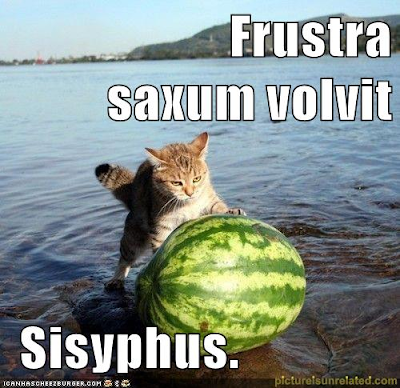
You will also meet Sisyphus, who was condemned in the afterlife to roll a rock up mountain, but never was never able to reach the top; the rock keeps rolling back down for all eternity. You can find out more at Wikipedia: Sisyphus.
To begin, here is a little slideshow (with cats) of the words you have seen before:
And here are today's proverbs:
1. Atlas caelum.
Atlas (holds up the) heavens.
Atlas caelum.
Atlas is in the nominative case here, while caelum is in the accusative, the object of the verb.
But where is the verb? The verb is implied here, based on people's familiarity with the myth: Atlas holds up the sky; that's just what he does.
You've seen some other proverbs with implied verbs in this earlier lesson: Capra gladium and Cornix scorpium.
The elliptical saying warns people to stay out of trouble. Don't get involved in a war with Zeus: otherwise, you might end up like Atlas, carrying the whole world on your back.
2. Nauta aratrum poscit.
(A) sailor demands (a) plough.
nauta a-RA-trum poscit.
The masculine noun nauta is one of those masculine nouns from the 1st declension, ending in -a. Many of these 1st declension masculine nouns are Greek in origin, and that is true here: nauta is the Greek word for "sailor" (ναύτης / naútēs), and you can see this root in English "astronaut," sailor among the stars.
The neuter noun aratrum means "plough," and you can see this root in English "arable." Because nauta is in the nominative case, you know that aratrum is in the accusative case.
The verb poscit means "demand, requires, asks for."
This is one of those proverbs about people acting foolishly: a sailor has no need of a plough, so it's foolish for him to request one.
This is another proverb about someone asking for something that they do not need and cannot use, just like the sailor and the plough in the previous saying.
Note the word order this time: the object comes first, speculum, and then the subject, caecus, and then the verb, poscit.
The word frustra is an adverb: "uselessly, in vain, to no purpose."
The verb volvit means "turns, rolls," and you can see that root in English "revolve." Here the word order is different yet again: an adverb first, then object of the verb, saxum, then the verb, volvit, and the subject last of all: Sisyphus.
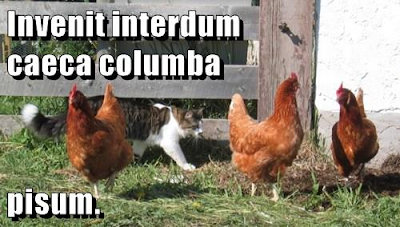
5. Invenit interdum caeca columba pisum.
(A) blind dove once-in-a-while finds (a) pea.
IN-venit in-TER-dum caeca co-LUM-ba pisum.
The word interdum is also an adverb, "once in a while, sometimes, meanwhile." The word is a compound in Latin, inter-dum, "between-while," i.e. "meanwhile."
The neuter noun pisum, "pea," is the origin of English "pea."
Because caeca columba is in the nominative, that lets you know that pisum is in the accusative.
You can see yet another word here: verb, invenit, adverb, interdum, subject, caeca columba, and then the object, pisum.
Compare the English sayings "Sometimes a blind pig finds a truffle" and "Even a blind squirrel finds a nut once in a while." There are similar sayings in other European languages too; for example, German: Auch ein blindes Huhn findet mal ein Korn, "Even a blind chicken can sometimes find a kernel."
Here is this week's vocabulary review: the slides have the English translations, plus links back to the original posts if you want to review the notes... along with the cats.
These are the instructions for how to use the slideshow as a quiz, and here's a link to the full-size show. And remember: the key is to repeat over and over and over again, OUT LOUD. That's how you learn languages: with your ears, not your eyes. So, as you click through each slide, make sure to read the Latin aloud and enjoy the sounds... and the cats!
I hope that will be a good review. The single hardest thing about learning a new language is the vocabulary, and that's because the only way to learn vocabulary is one word at a time. Learning the words in the context of a meaningful saying should help make the words stick. :-)
The focus for today's lesson features more accusative neuter nouns from the 2nd declension, ending in -um. By way of review, take a look at yesterday's sayings and make sure you can understand the neuter accusative noun in each of these sayings:
Telum ira facit.
Ignis aurum probat.
Veritas odium parit.
Nemo effugit futurum.
Copia fastidium facit.
And here is a little slideshow (with cats) of the words you have seen before:
And here are today's proverbs:
1. Durum durum destruit.
(A) hard (thing) destroys (another) hard (thing).
durum durum DE-struit.
The neuter adjective durum, "hard," is being used as a noun here: "(a) hard (thing), something hard." You can see this Latin root in English "durable."
One durum here is the subject of the verb, and the other durum is the object of the verb; the forms are the same!
The verb destruit gives us the English word "destroys." The verb is a compound: de-struo, "down-build," i.e. to tear down, destroy.
Literally, this might mean that to break a hard rock, you need a hard tool, like a big hammer. Metaphorically, if you are facing a hard problem, you are going to need to put some hard effort into solving it.
The neuter adjective vacuum, "empty," is being used as a noun here also: "(an) empty (thing)," i.e. a vacuum, as we say in English.
The word Natura is in the nominative case, so it is subject of the verb; that means vacuum is in the accusative case.
The verb abhorret, "recoils, shrinks back in horror," gives us English "abhor." The verb is a compound: ab-horreo, "away-horror," i.e. move away in horror.
3. Avarus aurum deum habet.
(A) miser has gold (as his) god.
a-VA-rus aurum deum habet.
You know all the words in this saying!
The word avarus is in the nominative case, so that means it is the subject of the verb, and aurum is in the accusative case, the object of the verb.
The word deum is the accusative form of deus. As you can see, both masculine and neuter nouns of the 2nd declension end in -um.
This is yet another saying that denounces the miser for his absurd and contemptible way of life: gold is not a god, but the miser worships his gold as if it were a god.
4. Lingua lapsa verum dicit.
(A) slipped tongue tells (the) truth.
lingua lapsa verum dicit.
The feminine noun lingua, "tongue," gives us English "language."
The feminine adjective, lapsa, "slipped," gives us English "lapsed," and this Latin phrase, lingua lapsa, is equivalent to the English phrase, "a slip of the tongue."
The neuter adjective verum, "true," is being used as a noun here also: "(a) true (thing)," i.e. "the truth." You've seen the masculine adjective, verus, before, but this is the first time you've seen the neuter form.
Since lingua lapsa is in the nominative case, that means verum is accusative here, the object of the verb.
The feminine adjective assidua, "persistent, constant," and gives us English "assiduous."
The feminine noun stilla, "drop (of liquid)," is the root in English "distill."
The neuter noun saxum means "rock, stone." You can see this root in English "sassafras" which comes from Latin saxifragus, "rock-breaking."
Because assidua stilla is in the nominative case, that means saxum is in the accusative case, the object of the verb.
The verb excavat gives us English "excavate." The verb is a compound: ex-cavat, "out-hollow, hollow out."
This is literally true: water really can wear away stone. Metaphorically, it means to be persistent, no matter how difficult your task might appear. This saying is also the opposite of Durum durum destruit; even though water is not a hard substance, it can, in fact, wear away rocks and stones.
The focus for today's lesson is something new: the accusative form of neuter 2nd-declension nouns.
So far, you've seen the accusative form of masculine 2nd-declension nouns, which have -us as the nominative ending and -um as the accusative ending:
Lupus agnum vorat.
The neuter nouns have -um as the nominative ending AND -um as the accusative ending. Yes, that's right: the nominative and accusative endings are the same for these neuter nouns!
Even more fascinating: all neuter nouns in Latin in all the declensions have the same nominative and accusative endings!
And most fascinating of all: all neuter nouns in ALL the Indo-European languages have the same nominative and accusative endings!
You can even this in English. No kidding! We only have accusative endings in our pronouns... so take a look at our neuter pronoun. The nominative and accusative endings are the same:
nominative: It takes time.
accusative: Please take it!
The pronouns "he," "she," and "they" have different forms — he/him, she/her, they/them — but the pronoun "it" is the same when it is the subject of a verb and when it is the object. Just like the neuter nouns in Latin and all the other Indo-European languages!
So, that means when you look at a neuter noun, you cannot tell if it is in the nominative or accusative case because the forms are the same. You'll need to figure it out from context. I've made notes about that for each of today's sayings: you'll find a neuter accusative form in each of those sayings.
To get started, here is a little slideshow (with cats) of the words you have seen before; almost all of today's words are words you know already:
And here are today's proverbs:
1. Telum ira facit.
Anger produces (a) weapon.
telum ira facit.
The neuter noun telum, "weapon," could be nominative OR accusative. So, you know the sentence is about a weapon, but you need to see what comes next to figure out what role it plays in the sentence.
The feminine noun ira is in the nominative case, so that means it is the subject of the verb, facit.
So, now you know that telum is in the accusative; it is the object of the verb.
The word order is definitely not like English: object-subject-verb.
2. Ignis aurum probat.
Fire tests gold.
ignis aurum probat.
The 3rd-declension noun ignis is in the nominative case, so you know it is the subject of the verb probat. The only thing a nominative noun can do is be the subject of the verb! Accusative nouns can actually do other things in addition to being the objects of verbs; you'll learn more about that later. For now, the thing to understand is that when you see a nominative noun, then you know it is the subject of the verb.
So, when you get to aurum, you know that this neuter noun is in the accusative case, the object of the verb.
These words come from the Roman philosopher Seneca; the complete form of the saying is: Ignis aurum probat, miseria fortes viros; "Fire tests god, and misfortune tests strong men." If you are curious about just what it means to test gold by fire, you can find out more at Wikipedia: Cupellation (fire assay).
3. Veritas odium parit.
Truth produces hatred.
VE-ritas O-dium parit.
The 3rd-declension noun veritas is in the nominative case, so it is the subject of the verb, parit.
That's how you know that the neuter noun, odium, is in the accusative case, the object of the verb.
These words are from the Roman comic playwright Terence; the full form of the saying is: Obsequium amicos, veritas odium parit, "Agreeableness produces friends; truth produces hatred." In other words, when you tell the truth, you risk losing friends.
You have not seen the verb effugit, "escapes, flees from," before, but you know the verb fugit. This is a compound of that verb: e(x)-fugit, "away-flee." The 3rd-declension noun nemo is in the nominative case, so it is subject of the verb, effugit.
That is how you know the neuter noun futurum is the object.
This time, the word order is familiar to you from English too: subject-verb-object.
The Latin word futurum is technically a future active participle of the verb "to be," so it means, literally, that-which-is-to-be. (You'll be learning about future active participles later.)
Today is a catch-up day to review any lesson(s) you missed this past week and/or to work on whatever kind of practice is most useful to you. There's also a slideshow below to help you review all the accusative nouns that you saw last week! Here are the lessons from this week, plus previous weeks:
And here's a slideshow with all the sayings from the week... and their cats! Maybe you can just read them out loud again. Really loud! To really remember them :-)
I also made a printable crossword PDF with this week's sayings as the prompts; screenshots below.
The focus for today's lesson is the masculine accusative nouns and adjectives that end in -um. The examples today have some more complex sentence structure — complex by English-language standards, that is. In Latin, these kinds of sentences are easy and natural. Hopefully by reading the sayings out loud, you'll get used to the Latin patterns so that they will feel easy and natural to you too!
To prepare, here is a little slideshow (with cats) of the words you have seen before:
Ancient Roman culture put a high value on friends and friendship, as you can see from this saying. Compare some other sayings about the positive value of friendship: Bonus liber amicus optimus and Amicus optima vitae possessio.
2. Incus robusta malleum non timet.
(A) strong anvil doesn't fear (the) hammer.
incus ro-BUS-ta MAL-leum non timet.
There are a lot of new words in this one:
The noun incus means "anvil," and don't let it fool you: it ends in -us, but it is not a masculine noun of the 2nd declension; it is a feminine 3rd-declension noun (stem incud-). The word "incus" is used in English to refer to a tiny anvil-shaped bone in the ear.
The adjective robusta gives us English "robust." The form is feminine because it agrees with the feminine noun incus. The root of this adjective is the Latin noun robur which means "oak, hardwood," and by extension then refers to anything that is especially strong.
The word malleum is the accusative form of malleus, "hammer." You can see this root in English "malleable."
The verb timet, "fears," and has the same root as an adjective you've seen already: timidus.
The saying is literally true: if the anvil had feelings, it wouldn't need to be afraid of the hammer, no matter how hard the hammer is going to hit it; the anvil is going to be just fine. So, be like the anvil and don't underestimate your inner strength: you can be confident in that strength.
3. Avarum irritat, non satiat pecunia.
Money provokes (the) miser, (it) doesn't satisfy (him).
a-VA-rum ir-RI-tat, non SA-tiat pe-CU-nia.
The verb irritat means "stirs up, provokes, excites," often with negative connotations. This is where we get English "irritate."
The verb satiat gives us English "satiate." This word shares the same root with a Latin word you've seen already: satis.
Just as friendship is highly prized, greediness is deeply condemned, both in Roman culture and in later Christian culture also. You've seen other sayings like this which mock the rich miser who is not able to enjoy the money he has accumulated: Avarus semper est pauper, Avarus semper eget, and Avarus ipse miseriae causa est suae.
4. Suum custodit quasi thesaurum draco.
(He) guards his (stuff) like (a) dragon (guards his) treasure.
suum cus-DO-dit quasi the-SAU-rum draco.
The verb custodit, "guards, watches," is related to a noun you've seen already: custos (root custod-).
The noun draco gives us English "dragon." The word is originally Greek: δράκων (drákōn).
This is another saying about misers: dragons were emblematic of rich people who sit on top of their treasure, greedily guarding their wealth, but not enjoying it. For an Aesop's fable on this subject, see the fable of The Dragon and the Fox.
5. Scientia non habet inimicum nisi ignorantiam.
Knowledge has no enemy but ignorance.
sci-EN-tia non habet ini-MI-cum nisi ignor-AN-tiam.
The word inimicum is the accusative form of the masculine adjective inimicus. That form is new to you, but you've seen the feminine form before: inimica. The adjective is being used as a noun here: "enemy."
The Latin word nisi means, literally "not-if, not if." There are a variety of different ways to translate it into English: "unless, except, but." The word "but" fits best here.
Given that science is under siege in my country right now, this saying has acquired a new currency, sad to say.