Today is a catch-up day to review any lesson(s) you missed this past week and/or to work on whatever kind of practice is most useful to you. Make sure you feel comfortable with all the verbs... and there are more verbs coming next week!
Here are the lessons from this week, plus previous weeks... and of course there's a random cat below. :-)
Here's a new game you might want to try: anagrams! These are all the new sayings from this week with their letters jumbled! Tip: read through the whole sentence and see which word you immediately recognize. That will help you to un-jumble the other words.
Oamr sagtemir tse uspomit.
Csiumde turca, turaan saant.
Ohmo uuhms, amaf muufs, iifsn insci.
Ima sdtuote tvloa.
Ehiandb copiud eixepilnelb iudolm.
Tancieis mxmiuam tiave ecdus.
Iln niis eunstv moho tes.
Paetrtas rose quma auuqmmn.
Maucs ntcea onn avcota.
Mmuoipt ecantedmmimu esiqu.
Raluuct miain aiholihopps set.
Ganam tse vsi ruia.
Sived nsuima ets, onn raca.
Ranaitgoin gesil onn suxecat.
Dxu nivevid atanur tse.
Saettarp uailqdi qmua ihiln.
Aulqe nmese, lsait ets ssmies.
Vearisbt ldetceta.
Auqils xgre, tasil exr.
Eflix iqu fpcaicusi.
I also made a printable crossword PDF with this week's sayings as the prompts. Screenshots below. I hope you will like the way the crossword puzzle gives you some hints as you try to supply the missing word.
I hope you are getting used to the Latin sayings with verbs! You'll see one familiar verb in today's sayings, praestat, and one new verb: cenat, "dines, has dinner." There is also a really nifty proverb-poem today; it is one of my favorites.
And here is a little slideshow (with cats) of all the words you have seen before; if you take a minute or two to review these sayings, you'll be better prepared for today's sayings! And if you have questions about any of the sayings on the slides, you can use the Sayings list to look up the translation and notes for that saying (the sayings there are linked to their blog posts).
Now here are today's proverbs:
1. Musca cenat non vocata. (A) fly eats, not summoned.
musca cenat non vo-CA-ta
The feminine noun musca, "fly," gives us English "mosquito."
The verb cenat means "dines, eats dinner."
You've seen vocatus before, and this is the feminine form: vocata, "called, summoned." It is feminine because it is describing the feminine musca. This is a passive participle, formed from the verb vocat. So, the verb vocat means "calls, summons," while the participle vocata means "called, summoned."
You'll be learning lots more about passive verbs in the weeks to come!
This saying is literally true: flies really do show up to eat without an invitation! Metaphorically, it applies to someone who exploits your hospitality without being invited.
2. Praestat aliquid quam nihil.
Something is better than nothing.
praestat A-liquid quam nihil
The pronoun aliquid is a compound, ali-quid, "some-thing," i.e. "something."
We use the saying "Something is better than nothing" in English too!
3. Magna est vis auri.
Great is (the) power of-gold.
magna est vis auri
The word auri is the genitive form of aurum, "gold." You can see this Latin root in the name El Dorado, the mythical city of gold.
Compare a saying you saw earlier: Magna vis pecuniae. The phrases visauri and vispecuniae are synonyns, "the power of gold" and "the power of money."
4. Quale semen, talis est messis.
As (the) seed, so is (the) harvest.
quale semen, talis est messis
The adjective quale is a neuter form, agreeing with the neuter noun semen, "seed," which is the origin of the English word "semen."
You've seen the masculine and feminine form qualis many times previously, but this is the first time you have seen the neuter form.
The feminine noun messis, "harvest," takes a feminine adjective: talis. Compare the English saying, "As you sow, so shall you reap."
5. Homo humus, fama fumus, finis cinis.
(A) person (is) earth, fame (is) smoke, (the) end (is) ash.
homo humus, fama fumus, finis cinis
The noun humus, "earth, ground," is a feminine noun of the second declension. There are not a lot of feminine nouns in the second declension, but this is one of them! Unlike the other word pairs, the words homo and humus really are etymologically related; both come from the Indo-European root dʰéǵʰōm.
The noun cinis, "ash," can be seen in English "incinerate."
As you can see, this saying is like a tiny poem, with each pair of words being connected both through their meaning and through their sound.
It's also possible to punctuate the little poem this way. You can decide which you like best!
Homo? Humus. Fama? Fumus. Finis? Cinis.
"What is a person? Earth. What is fame? Smoke. What is the end? Ash."
This is a medieval Latin saying, as you can tell from the rhymes. Medieval Latin poets were very fond of rhyme, but rhyme was not a feature of classical Latin poetry. This saying belongs to the "Memento mori" ("remember (that you are going) to die") genre; you can read more about that at Wikipedia: Memento mori.
You'll be learning some more -at verbs today; here is a list with all the new ones plus the ones you've already learned:
curat: cares for, cures
delectat: delights, pleases
errat: errs, makes a mistake
excusat: excuses, makes an excuse
obstat: stands in the way, blocks
praestat: stands out, surpasses
sanat: heals, makes healthy
volat: flies, goes quickly
And here is a little slideshow (with cats) of the words you have seen before:
Here are today's proverbs:
1. Medicus curat, natura sanat.
The doctor cures; nature heals.
ME-dicus curat, na-TU-ra sanat
Latin medicus means "physician, doctor," and you can see this root in English "medical."
The verb curat means "cares for, cures," and it is the root of English "cure" and also "curator" and "curious."
The verb sanat means "heals, makes healthy," and you can see this root in English "sanitize" and "sanitary." The meaning has shifted to mental health in English "sanity" and "insanity."
As you can see, the proverb contrasts the powers of the medicus and natura. The doctor takes care of the patient, curat, but it is nature herself who brings health: sanat. The saying has its own Wikipedia article.
2. Dux vivendi natura est. Nature is (the) guide of-living. dux vi-VEN-di na-TU-ra est
The 3rd-declension noun dux, "leader," is a noun that can be either feminine or masculine, depending on context. In this context, dux is feminine; natura, feminine, is the leader. The stem of dux is duc- which gives us English "duke." In English, though, "duke" is masculine and has a separate feminine form, "duchess." Latin dux does double-duty: both masculine and feminine.
The word vivendi is the genitive of vivendum, a verbal noun (remember gerunds?). Vivendum is from the verb vivere, "to live," so it means "living."
This saying echoes the previous saying, respecting the power of nature. We should live "naturally," letting natura be our guide to healthy living.
3. Ignorantia legis non excusat.
Ignorance of-the-law doesn't excuse.
igno-RAN-tia legis non ex-CU-sat
You know all the words in this saying, and it's just a variation on the saying you saw earlier this week: Ignorantia non excusat. The difference: legis, giving you the phrase ignorantia legis: ignorance of-the-law. The word legis is the genitive of lex, "law."
Compare the English saying: "Ignorance of the law is no excuse."
4. Praestat sero quam numquam.
Late is-better than never.
praestat sero quam numquam
The verb praestat is a compound: prae-stat, "before-stands, out-stands," i.e. "stands out, exceeds, is better." Compare a similar compound you saw earlier this week: ob-stat, "in-the-way stands, blocks."
The adverb sero means "late." It does not have English derivatives, but if you know French, this is the origin of soir, "evening," i.e. late-in-the-day, and likewise Italian sera.
Compare the English saying: "Better late than never."
This is a great saying for anyone out there learning Latin later in life: Praestat sero quam numquam!
5. Dives animus est, non arca.
(The) soul is rich, not (the) coffer.
dives A-nimus est, non arca
The feminine noun arca means a "chest" or "box," and often specifically a box for money, which is why I have translated it as "coffer." Latin arca can also mean "coffin," and I liked the way English "coffer" has a hint of "coffin" about it. (Both those English words come from Latin cophinus, a borrowing from Greek kophinos.)
And yes, Latin arca is the origin of English "ark," as in Noah's Ark and also the Ark of the Covenant, the box containing the tablets given to Moses on Mount Sinai.
The idea behind this saying is that earthly riches, like the money contained in a money-box, are not really riches at all; the true riches are spiritual riches, the riches of the animus, the soul.
The saying appears in the writings of the Roman politician and philosopher Cicero.
Per usual on Wednesday, I'll be doing a vocabulary slideshow quiz, with cats too! Here's a link to the full-size show. You can use this as a way to see how much of the vocabulary you are retaining; there's an English prompt and also some Latin sayings to help jiggle your memory. The next slide will tell you if you are correct! And if you want to review the notes and translation for a saying, you can use the Sayings list or Dictionary, which both have links to the original posts. And remember, always read out loud. You learn languages with your EARS, not your eyes.
If you need to be retaining more vocabulary, you can think of what forms of engagement benefit you most: reading out loud, writing things out by hand, making flashcards, using the audio for dictation, etc. etc. Try out different strategies, and then you'll discover what works best for you.
And here are just a few of the cats from the slides:
There are some new 1st-conjugation verbs, ending in -at, in today's sayings.
volat: (she/he/it) flies, is flying
delectat: (she/he/it) pleases, delights, is pleasing
Notice that I have used both the English present tense ("flies," "pleases") and present continuous ("is flying," "is pleasing") in those translations. The Latin present tense verb embodies both of those meanings, so if you have to translate into English, that means you have to choose between present and present continuous in your English version.
To get ready, here's a little slideshow (with cats) of the words you have seen before:
And here are today's proverbs:
1. Iam testudo volat.
The turtle is now flying.
iam tes-TU-do volat
The adverb iam means "now" or "already," depending on context. When used with a future tense verb, it can even mean "soon."
The masculine noun testudo (genitive: testudinis) means "turtle" or "tortoise." The word is based on Latin testa, a piece of "hard clay tile," or a piece of "shell," so the turtle is "the shell-y one." (That etymology is especially for my friends living in the Testaccio neighborhood of Rome!)
The verb volat means "flies" and it can also, metaphorically, mean "goes quickly." You can see this Latin root in English "volatile."
This saying can be used when something is going quickly that you expected to go slowly. It can also refer to a foolish project that will not end well, as in the Aesop's fable where a tortoise persuades an eagle to take him up into the air, a ridiculous venture that ends with the flying turtle crashing to the ground. Here's that fable: The Tortoise and the Eagle.
2. Brevitas delectat.
Brevity is pleasing.
BRE-vitas de-LEC-tat
The feminine noun brevitas gives us English "brevity." It is a noun formed from an adjective you already know: brevis, "brief, short."
The verb delectat means "pleases, delights," and this Latin root gives us English "delight" and also "delectable."
Since brevity is the key feature of proverbs, it makes sense to have a proverb that praises brevity. Compare the English saying, "Short and sweet."
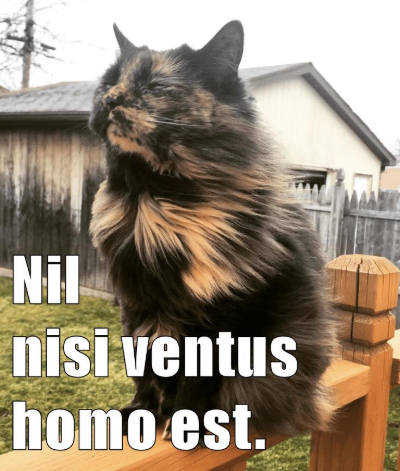
3. Nil nisi ventus homo est.
(A) person is nothing but wind.
nil nisi ventus homo est
You know all the words in this saying already!
The idea here is that a human life is like a breath of wind: it's here, and then it's gone, insubstantial as a breeze. Compare a similar saying that you say earlier: Juventus ventus.
4. Qualis grex, talis rex.
As (the) flock, so (the) king.
qualis grex, talis rex
The word grex (genitive: gregis) means "flock." You can see this Latin root in English "congregate," "segregate," etc. and also "gregarious" and "egregious."
You've seen many of these qualis...talis... proverbs already. This one has the virtue of rhyming: grex-rex. The idea is that if you look at the leader of a group, you know something about the members of that group: a good "flock" will have a good "king," while a bad "flock" will have a bad "king," etc.
5. Habendi cupido inexplebile dolium.
(The) desire of-having (is a) pot that-cannot-be-filled-up.
ha-BEN-di cu-PI-do inex-PLE-bile DO-lium
The word habendi is the genitive of habendum, one of those verbal nouns that you've been before; habendum is from the verb habere, "to have," so habendum means "having." (Verbs like habere with an -e- vowel belong to the second conjugation, which you will be learning week after next.)
The neuter adjective inexplebile, "cannot be filled up," is a compound: in-ex-plebile, "un-out/up-fillable." We don't have an English word from inexplebile, but you can see the exple- root in the English word "expletive."
The neuter noun dolium is a "pot" or "jar." Because it is a neuter noun, it takes a neuter adjective: inexplebile dolium.
The paradox of a pot that cannot be filled up appears in the ancient myth of the daughters of Danaus, the Danaids, who had to try to fill water pots that had a hole in the bottom; you can find out more at Wikipedia: Danaids.
So far the only verb you have seen in Latin is "is," est. Starting today, there will be new verbs in every lesson. :-)
Like the nouns which are divided into different classes based on their endings, the same is true of verbs. The different kinds of nouns are called declensions, while the different kinds of verbs are called conjugations. There are 4 conjugations, and we'll be starting this week with the 1st conjugation.
The vowel ending that is the sign of the 1st conjugation is the letter A.
In addition to a distinctive vowel in the ending, verbs also have endings that let you know the person (1st, 2nd or 3rd) and number (singular or plural). The 1st person verbs are for "I" (singular) and "we" (plural) and 2nd person verbs for "you" (singular) and "you" (plural), while the 3rd person verbs are for "she, he, it" (singular) and "they" (plural). We'll be working on the plural verbs later; for now, the focus will be the 1st, 2nd and 3rd persons, singular, starting with the 3rd person, the most common verb form.
So, these are the 3rd-person verbs you will see in today's proverbs; the A is the 1st-conjugation vowel, and the T is the 3rd-person singular ending, to the ending is -at.
obstat: she/he/it blocks, stands in the way
excusat: she/he/it excuses, absolves
errat: she/he/it errs, makes a mistake
In addition to proverbs with these verbs, there are also some proverbs just with nouns. That way, you won't forget that it's possible to make statements in Latin even without using a verb.
You'll recognize some of the words in today's sayings too; here's a slideshow of the words you've seen before:
And here are today's proverbs:
1. Nihil obstat.
Nothing stands-in-the-way.
nihil obstat
The verb obstat is a compound, ob-stat, "in-the-way stand," i.e. "block." The Latin verb stat is a cousin of English stand; they both come from the Indo-European root steh₂. You can also see Latin obstat in the English word "obstacle."
The words Nihil obstat were printed inside books that were approved by the Catholic Church. In other words, nothing stood in the way of the book being printed; the church censors did not object to the book's contents. These words even have their own Wikipedia article: Nihil obstat.
2. Ignorantia non excusat.
Ignorance doesn't excuse.
igno-RAN-tia non ex-CU-sat
Latin ignorantia is the origin of English "ignorance." It is a compound word: i(n)-gnorantia, "not-knowing."
The verb excuse is the origin of English "excuse" (the verb). The word is a compound in Latin: ex-causa, "from-cause," i.e. to not be the cause of something, to be free of blame.
Compare the English saying, "Ignorance is no excuse."
3. Haud semper errat fama.
Rumor isn't always wrong.
haud semper errat fama
The word haud is a more colloquial way of saying "no" in Latin, a synonym of non. So, you could restate this as: Non semper errat fama.
The verb errat is the source of English "err." It literally means "to wander," as in the phrase "knight errant." Metaphorically it also has the meaning of "make a mistake," in the sense of wandering off the path, goign the wrong way, being in error.
The idea is that rumor is often wrong (as in the earlier saying: Mendaxfama, "Rumor is a liar"), but it is not always wrong: haud semper.
4. Aut mors aut victoria.
Either death or victory.
aut mors aut vic-TO-ria
Compare the aut...aut... here to a similar saying you saw last week: Aut Caesar aut nihil.
5. Amicus optima vitae possessio.
(A) friend (is) life's best possession.
a-MI-cus OP-tima vitae pos-SES-sio
Latin possessio gives us English "possession." Knowing that English word, you won't be surprised to find that the stem of the Latin word is possession- (genitive: possessionis).
And don't forget about how the genitive form works: vitae is the genitive of vita, so it means "of life, life's." Notice also how the adjective-noun phrase, optima possessio, wraps around the genitive: vitae, "life's best possession." That kind of word order is impossible in English but completely natural in Latin.